Abstract expressionism
Post-war American abstraction, with which New York replaced Paris as the centre of the art world after 1945. It is among the strongest and most expensive segments of the art market.
Abstraction
Abstraction is an artistic approach that gives up the faithful depiction of reality and lets colour, shape, line and rhythm speak for themselves. The name comes from the Latin abstractus, meaning drawn away, and since the beginning of the twentieth century it has changed what we expect of a picture.
Appreciation of art over time
The appreciation of art over time describes how the value of a work you hold grows. Art can make money, but always with risk, and over a longer run rather than overnight.
Art and artificial intelligence
Artificial intelligence (computer systems that learn and generate images or texts themselves) is now one of the key topics of the art market. It enters the market as a tool for making art, as an aid in verifying authenticity, and as a question we are still working out how to answer.
Art and brands (collaborations)
Collaborations between artists and fashion or luxury brands connect the world of galleries with the world of products. They raise an artist's visibility and the value of their work.
Art brut and naive art
Art brut is art made outside institutions and the academic frame, often by artists with mental illness (art brut, “raw art”). The term was coined by Jean Dubuffet; in the Czech context it includes Anna Zemánková, and interest in it on the market is growing.
Art Deco
Art Deco is the decorative, elegant style of the 1920s and 1930s, joining geometry to luxurious materials, and it still feels refined and timeless today.
Art fair (Art Basel, Frieze, TEFAF)
An art fair is a place you go not only to look at art but to buy it (galleries sell their artists' work directly here). Picture a large hall full of stands where well-known names stand next to young discoveries.
Art historian
An art historian is a specialist who studies and interprets the visual arts in their historical and cultural context. Put simply, this is the person who can tell you who made a work, when and why, and what it means.
Art in public space
Art in public space means sculptures and installations placed in the city itself, commissioned either by developers or through public competitions. Here the scene is dominated by prominent names such as David Černý — and by the debate about quality and selection that comes with them.
Art-secured lending
An art-secured loan is a credit facility in which an art collection serves as collateral. Abroad it is a common service; here it is still the exception — and an opportunity into which the market has yet to grow.
Artist record
An artist record is the highest price ever reached by a work by a given artist; in reports you spot it by the dagger beside the name. Interestingly, a record often falls abroad rather than at home.
Auction vs private sale
Auctions are only the visible tip of the market, while most trade in art happens privately, off the public record. That is the source of the grey area, where data is missing and value is harder to establish.
Auctioneer
The auctioneer is the person who conducts a sale, takes the bids and closes the sale with a fall of the hammer. They set the pace of the room and manage telephone and online bids as well.
Bidding limit
A bidding limit is the ceiling a bidder sets in advance and is willing to go to at a sale. It protects them from being carried away by emotion in the room.
Blue chip
Blue chip (proven masterworks by the most sought-after artists) is the safest floor of the art market, where value rises steadily and reliably over the long term. It is a safe bet — but that safety comes at the highest price.
Buyer's premium
The buyer's premium is the auction house's commission, which the buyer pays on top of the hammer price. It is why the final price is always higher than the one at which the auctioneer's hammer falls.
Catalogue raisonné
A catalogue raisonné is a complete listing of one artist's work, piece by piece. On the art market it acts as the arbiter of authenticity: having a place in it, or not, can decide the entire value of a painting.
Censorship and art
Censorship is the tension between an artist's freedom and the pressure of politics or institutions wanting to determine what may be shown. It ranges from interference with works to decisions about who will represent a country at a major exhibition.
Chandelier bid
A chandelier bid is a bid the auctioneer calls by gesturing into thin air, as if towards the chandelier, in order to lift the price towards the first real offer. It is legal, yet it belongs to the greyer corners of the saleroom.
Collection custodian
The custodian is the quiet guardian of a collection (from the Latin custos, guardian), caring for works so that they survive in the best possible condition for the generations to come. It is a less visible role, but an absolutely essential one, without which no gallery or museum could function.
Conceptual art
Conceptual art rests on the idea, not on how a work looks. An artwork can therefore be a text on a wall, a performance, instructions in an envelope, or simply an idea you hold in your head.
Contemporary art
Contemporary art reflects the issues of the day and is defined not by style but by time and approach. It is the most dynamic and most alive floor of the entire art market.
Criteria of good art
The criteria of good art are four guides by which to recognise a work with a chance of standing up over time and on the market (investment quality): innovation, an informed grasp of history, relevance, and the artist's fidelity to their purpose.
Cubism
Cubism is a movement in painting and sculpture that breaks reality down into geometric shapes and several viewpoints at once. The name comes from the French word cube.
Curator
A curator devises the concept of an exhibition and chooses the works — the person who gives an exhibition its meaning and its story. The word comes from the Latin curare, to care for.
Dating and backdating a work
Dating establishes which year a work belongs to, and thereby affects both its placement and its price. With conceptual artists there is the added question of whether the date of the idea or the date of physical making decides.
Digital art
Digital art is made with the help of digital technologies, software or algorithms, and today ranges from digital graphics to works based on data and artificial intelligence. In a few decades it has gone from a marginal experiment to a full part of the gallery and auction scene.
Documenta and Manifesta
Documenta and Manifesta are two major European surveys of contemporary art, attended for a sense of what the scene is currently concerned with. When a city hosts one, local artistic life usually comes fully alive.
Editions and limitation
With prints, sculptures and photographs, a work is produced in a predetermined limited number. Controlled scarcity sustains value: a smaller run means a higher price, overproduction pushes it down.
Emotional value vs investment
Emotional value versus investment describes how art is bought with the heart and with the head. Emotion comes first, but a good choice can be backed up with figures too.
ESG and art
ESG is a lens of sustainability and responsibility that art collectors increasingly apply. They want to know what subject and what awareness a work — and its artist — carries.
European Capital of Culture
European Capital of Culture is a title that turns a chosen city into a cultural centre for a year and gives its art scene a running start. Pilsen has held it here, and Graz in neighbouring Austria.
Expressionism
Expressionism is a movement devoted to the expression of emotion, inner states and subjective experience. Instead of a faithful image of the world it offers an image of the soul, often with colour sharp as a nerve and line stretched to breaking point.
Fakes and forgeries
Imitations passed off as genuine works. The risk grows above all with sought-after artists who are no longer living, and the best defence is a vetted source and honest documentation.
Fauvism
Fauvism is a painting movement of the early twentieth century famed for its explosive colour and loosened form. It freed colour from reality and let it sing purely for joy, energy and strong feeling.
Fractional ownership
Fractional ownership means that several people share a single artwork, each owning a share in it. It is a way into collecting without millions in the bank, and one of the fastest-growing trends on the art market.
Gallerist
A gallerist is the person who represents an artist, builds their career and handles the sale of their work for a commission. They are the link between studio and collector, able to turn a talented artist into a name people talk about.
Gallery representation
Gallery representation is the relationship in which a gallery promotes an artist, sells their work and takes a commission for doing so. It is an alliance that can build a talented artist into a name — and into a price level.
Generations of collectors
Generations of collectors describes how differently people buy according to age and taste. Every generation is looking for something else on the art market, from status to new forms of ownership.
Geographical shifts in the market
Geographical shifts describe how the centres of the art trade move from place to place. They show that none of them is fixed once and for all.
Hammer price and final price
The hammer price is the sum at which the auctioneer's hammer falls; the final price is what the buyer actually pays. There is a substantial gap between them, and it is worth knowing which figure you are looking at.
How to read auction figures
Reading auction figures means weighing three metrics at once — total turnover, the number of works sold and the record price. Only together do they make sense; a single figure without context easily misleads.
Hyperrealism
Hyperrealism is painting so faithful to reality that at first glance you could easily mistake it for a photograph. Demand for it tends to fluctuate; in the Czech Republic it is represented by Jan Mikulka, among others.
Impressionism
Impressionism is a painting movement of the last quarter of the nineteenth century that chased light, the moment and atmosphere rather than detail. Once derided, it is now among the most expensive and best-loved chapters in the history of art.
Informel
Informel is post-war structural abstraction built on matter, material and chance, and in Czechoslovakia it became the principal unofficial artistic tendency.
Inheritance tax and the market
Inheritance tax is the tax an heir pays on the value of inherited property, an art collection included. Abroad it tends to be high, and so it significantly affects when and how collections appear on the market.
Institutional collections
Institutional collections are the art holdings of major museums and galleries; entering one is a seal of quality for an artist. Acquisition into such a collection is usually a marked impulse for a work's market value as well.
Investment horizon
The investment horizon is how long you hold a work before it makes sense to sell it. Art is not a quick trade, so it is counted in years rather than months.
Kawaii aesthetics
Kawaii is the aesthetics of cuteness — childlike, endearing characters — and is especially strong in Asian and contemporary art. It rests on the idea that the pleasing and playful can also be profound.
Kitsch art
Kitsch art is a category that knowingly balances between kitsch and high art, turning a banal, pleasing motif into a collectable object. It plays with where kitsch actually ends and art begins.
Liquidity
Liquidity — how easily, how quickly and for how much you can sell a work when you need to — is an often overlooked yet crucial risk of collecting. Art is not a share you can turn into cash in a second.
Lithography
Lithography is a printmaking technique using a stone or plate, ingeniously exploiting the fact that grease and water repel each other. It allows for delicate draughtsmanship and has for centuries been a favourite way of getting art into more homes at once.
Market correction and the cycle
A correction is the natural settling of prices after a period of sharp growth, when the market returns to a more sustainable trajectory. It does not mean a crisis, more a pause between breathing in and breathing out.
Market reports and indices
Reports and indices are the tools that let you find your bearings in the art market without having to visit every auction and gallery yourself. They give numbers a context, because a number without a story usually leads nowhere.
Median and average price
The average price can be pushed up by a few record sales, whereas the median price (the middle value) shows how an ordinary work is doing. That makes the median a healthier indicator of the market's real state.
Minimalism
Minimalism sets emotion and storytelling aside and concentrates on the essence of objects themselves: their shape, colour, material and the space they occupy. It is art that says less so that the essential can come through.
Modern art
Modern art covers roughly the period from the 1860s to the 1960s — the time when artists consciously turned away from academic rules and began looking for entirely new forms. It should not be confused with contemporary art, which is being made only now.
NFT
An NFT is a way of documenting ownership of a digital work via blockchain. A steep fall followed the great boom, but the very best works are holding their position.
Online viewing rooms
Online viewing rooms are digital selling “rooms” where you can look at a work and buy it straight from the screen, without sitting in a saleroom. They came fully into their own after Covid and extended selling far beyond the walls of auction houses and galleries.
Op art
Op art (optical art) is a movement that plays with the eye through geometry and sharp contrast, so that a surface appears to ripple and move even though it is entirely still.
Opening price and estimate
The opening price is the figure a sale starts from; the estimate is the range within which the house expects the value of a work to fall. Two figures that tell you more about a sale than you might think.
Orphic cubism
Orphic cubism is the term Guillaume Apollinaire gave to the colourful, musically inclined branch of cubism (orphism). In František Kupka's work around the exhibition of 1912 it became a herald of pure abstraction.
Performance
Performance is a live event bounded in time and space in which the artist's own body is the primary medium. It happens here and now, once and for all, and its magic lies precisely in that transience.
Photography
Photography is an image made possible by the sensitivity of certain substances to light. In under two centuries it has gone from a technical record to an art form in its own right, held in museum collections and offered at leading auctions.
Pop art
A movement of the 1960s that takes consumerism, advertising, comics and celebrity as its subject. Led by Andy Warhol, it became one of the most sought-after segments of the art market.
Portfolio allocation to art
Portfolio allocation to art is about what share of your assets it makes sense to hold in art. Art figures here not as speculation but as a way of spreading value alongside shares or property.
Post-war art
Post-war art is the work made roughly from 1945 to the 1960s, responding to the war just lived through, to a divided world and to the rise of consumerism. For collectors it is an appealing band between the classics and the present.
Pre-sale exhibitions
Pre-sale exhibitions let you look at works up close before they go under the hammer and often disappear into private collections. In London or Paris they are frequently small free shows of masterworks.
Price levels on the Czech market
Price levels on the Czech market are the indicative tiers into which works fall by price, from inexpensive prints to works by the leading names running into hundreds of thousands. It is a clear map to keep a new collector from getting lost.
Pricing by surface area
Pricing by surface area is a widespread if simplifying method of valuation in which the price rises in proportion to the size of the work. It explains why a large canvas costs several times more than a small one.
Primary and secondary market
The primary market is the first sale of a work directly from the artist or their gallery; the secondary market is every resale after that, typically through auctions. Slightly different rules apply on each, and prices behave differently too.
Provenance
Provenance is the history of an artwork's origin and ownership — its pedigree from the moment it left the studio to the present day. And believe us, a pedigree can work wonders on a price.
Qualified investors' funds (FKI)
Qualified investors' funds are investment funds focused on art. They are a route for anyone who wants to enter the art market but does not want to handle the selection and management of individual works themselves.
Rankings of best-selling artists
Rankings of best-selling artists are reference tables from which an artist's position on the market can be read. They work well as a map, but the ranking alone does not tell you everything.
Ready-made
An ordinary object raised to the status of an artwork, a principle introduced by Marcel Duchamp. It opened the door to conceptual art, minimalism and pop art.
Rediscovered artists
Artists the market comes upon again after years and finally appreciates. It is also a way of restoring credit, in retrospect, to long-overlooked names.
Refining your taste
Refining your taste is the gradual sharpening of the ability to recognise quality and depth in an artwork. It develops with time and experience, much as it does with wine.
Sale on consignment
Sale on consignment means a work stays the property of its owner until it actually sells (the auction house or gallery merely offers it for a commission). It is often how works that did not find a buyer first time round come back into play.
Sell-through rate
The sell-through rate is the share of lots in a sale that actually sold, and it often says more about the health of the market than a single striking record. Once you start following it, you will read catalogues between the lines.
Single-owner collections
A single-owner collection is an auction devoted to the collection of one respected collector. The shared origin and story pull the prices of all the lots upwards, because the buyer also acquires a piece of curatorial taste.
Socially engaged art
Socially engaged art is work whose material is not paint or stone but working with people, a community and a social theme. Here the work is the encounter itself and whatever arises between people.
Solo exhibition at an institution
A solo exhibition at an institution is a show devoted to a single artist at a prestigious house such as the National Gallery, the Rudolfinum or GHMP. Such an event significantly raises an artist's reputation and prices — with some names, by an order of magnitude within a single year.
Suprematism
Suprematism is Kazimir Malevich's purely geometric abstraction, which refuses to imitate reality and seeks a pure form made only of simple shapes and fields of colour.
Surrealism
A movement that opens the door to dreams, the unconscious and the irrational, drawing on Freud's ideas. It arose in the 1920s around André Breton's manifesto and remains one of the most sought-after chapters of modern art among collectors.
The 3D rule (death, debt, divorce)
The 3D rule is a collector's shorthand for the three life situations that most often bring great collections to market. It explains why a work that was out of sight for decades appears just now.
The artist as a brand
An artist as a brand is one who, alongside the works themselves, builds their recognisability, their name and their presence on the market. A strong brand sustains demand, but it also places an obligation on the artist.
The auction season
The auction season is the period holding a concentrated wave of major evening sales (the market has two peaks a year). Traditionally the most celebrated works, and the tensest contests between collectors, are drawn into these few weeks.
Third-party guarantee
A third-party guarantee is a minimum price for a work agreed in advance, which sustains its saleability even in a weaker season. As a buyer it is worth knowing that such an arrangement may stand behind a work.
Trend-driven demand
Trend-driven demand is the appetite for whatever everyone simply must have, and it can catapult a work's price upwards. It can evaporate just as fast, which is why we never read records as a certainty.
Ultra-contemporary and young contemporary
Ultra-contemporary and young contemporary is the youngest floor of the market, made up of works by the youngest living artists. It can bring rocketing price jumps within a single auction, but it also carries the greatest risk of a bubble.
Venice Biennale
The Venice Biennale is the most prestigious art exhibition in the world, held every two years. It is not a market but a selection of the best of what is happening in the art world right now.
Verifying authenticity (blockchain and AI)
New tools that document a work's authenticity by technological means, from blockchain certificates to artificial intelligence. The pitfall remains what the database gets filled with.
Video art and new media
Video art is art that works with the moving image, video and technology instead of canvas or bronze. Here the work is not an object but an experience unfolding in time.
Viennese Actionism
Viennese Actionism is a radical performative movement of the 1960s that worked with the human body, blood and ritual (actionism). The action itself was fleeting, so what is traded today is mainly what remains of it — documentation, relics and certificates.
Wet paint
Wet paint means brand-new works by young artists that travel straight from the studio to auction. It is an alluring floor of the market where prices shoot up fastest — and fall just as fast.
Women in the art market
Women's share of the art market is growing on both sides — as collectors and as valued artists. The market is also systematically rediscovering women artists who were previously left in the shadows.
Work of national value
A work of national value is an artwork of exceptional importance whose export the state blocks so that it stays in the country. It is a way for a nation to hold on to the most precious part of its own cultural heritage.
Works on paper
Works on paper are drawings, watercolours and prints, which tend to be more affordable than painting on canvas. That is precisely why they are often the way in for new collectors.
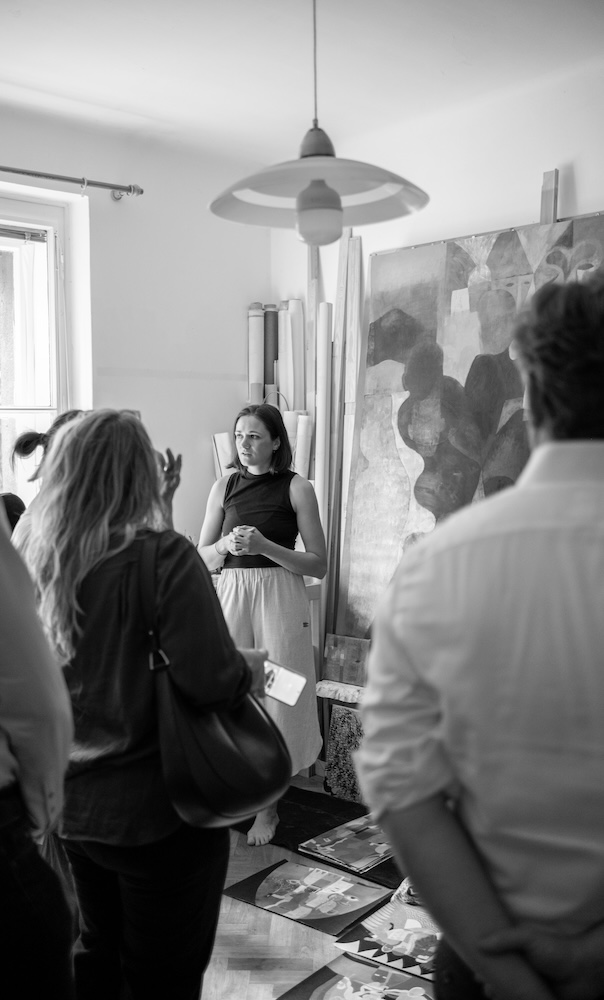
Become part of Art Part Club
Art Part Club is a space for inspiration, education, sharing and buying art. Join a community of people who are curious about the art world and want to get to know it up close.

Download the ArtPartClub app