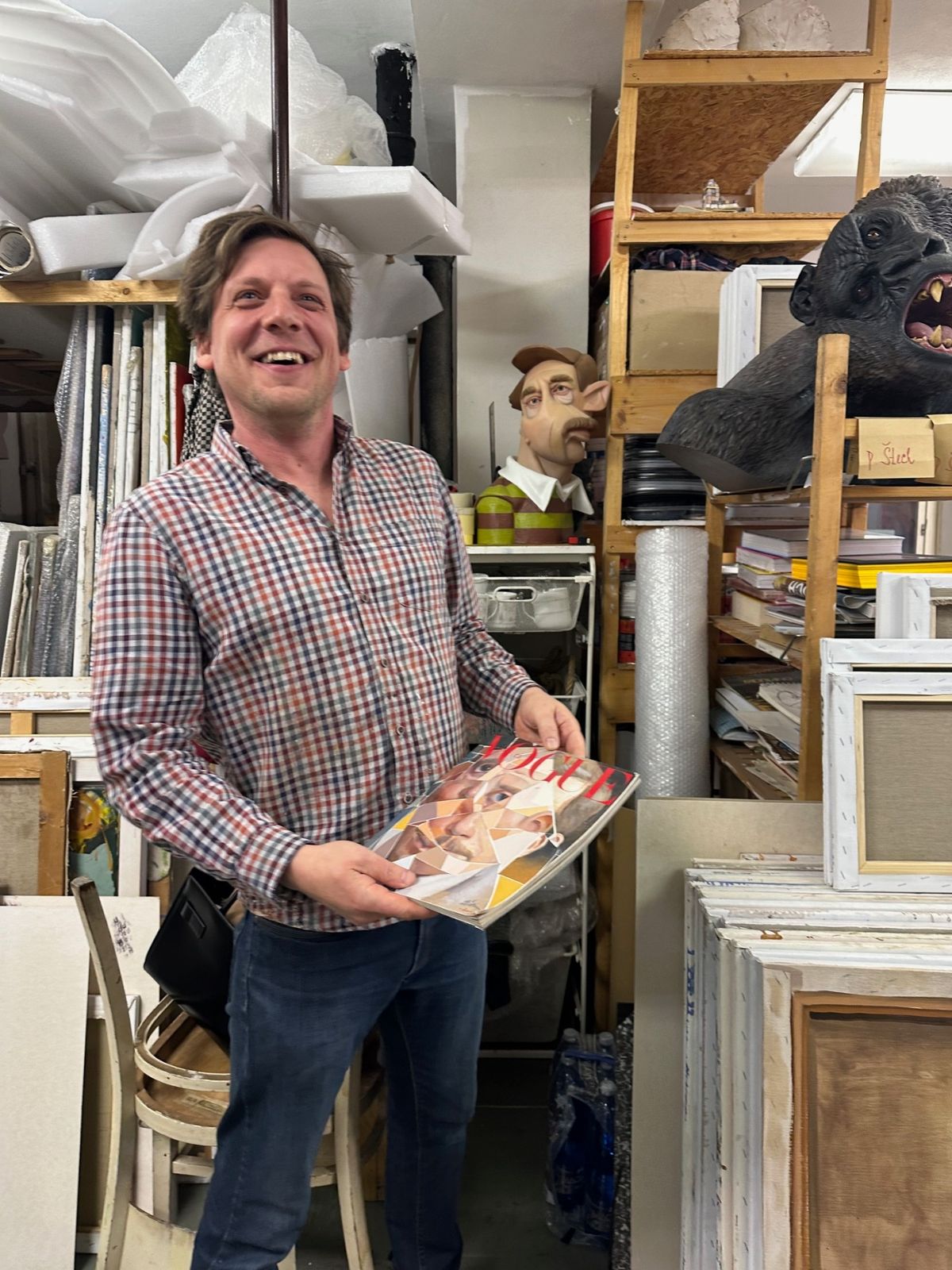
Václav Havel broken into Cubist planes, as if painted by Picasso. Michel Houellebecq as a larger-than-life bust in a shop window. Picasso, Basquiat, Madonna, Willem Dafoe and Lenin, each one shattered and put back together. Adam Štech (b. 1980) is a painter and sculptor who borrows techniques from art history as if from a well-stocked workshop, and uses them to portray our age with irony and black humour. A laureate of the Critics’ Award for Young Painting, he is among the most frequently exhibited names in contemporary Czech art. Let us look at why he is worth following.
Adam Štech was born in Podbořany. In 1999 he graduated from the Secondary School of Graphic Arts in Jihlava, and from 2001 to 2008 he studied painting at the Academy of Fine Arts in Prague (AVU), first in the studio of Jiří Sopko, a distinctive colourist and one of the great figures of Czech painting, and then with Vladimír Skrepl. During his studies he won the studio prize and went on an exchange to Bellas Artes in Porto, Portugal.
Success came early. In 2011 he received the Critics’ Award for Young Painting, presented by the Association of Art Critics and Theorists. His early works were provocative: he worked with human hair, and in the painting LCF (2009) he replaced the head of a Madonna in a blue cloak with an abstract Pop Art object. The work is now in the collection of Kunsthalle Praha. By his own admission, his older pieces were more aggressive. He sees his newer paintings as deeper and more personal.
What makes Adam Štech’s painting so recognisable? Above all, his work with Cubism. From it he takes fragmentation, abbreviation and deformation (breaking a figure into geometric planes that reassemble in an unexpected order). He is interested in optical illusion: how the brain can read a distorted image and fill in the missing parts. He alternates between Synthetic Cubism (colourful, simplified planes like a collage) and Analytic Cubism (a breakdown of form into small, muted facets).
Cubism is not his only source of inspiration, though. He mixes techniques from the Baroque, Expressionism and Modernism, and admires Rubens’s virtuosity and colour. He paints in oil, works with stencils, and makes plaster mosaics, drawings, colour prints and sculptures. He chooses the medium to suit the motif. Nor is he afraid of new tools: he uses artificial intelligence much as he once used Photoshop, for instance when working out the modelling of figures.
The result is collages in many senses. The figures are caricatured and placed in absurd, humorous situations. Often they are his friends, his family and himself. Try stopping in front of one of his portraits and looking for where the face falls apart and where it comes together again. Can you tell who it is? And how much of the likeness are you filling in yourself?
Adam Štech’s best-known work is the Cubist portrait of Václav Havel, which appeared on the cover of Vogue for the 30th anniversary of the Velvet Revolution. Besides Havel, he paints Picasso, to whom he returns repeatedly, as well as Basquiat, Madonna, Willem Dafoe, Elon Musk, Andrej Babiš, Milan Knížák and a three-metre Lenin for the Lidový dům (People’s House). The series explores what actually makes up a human likeness and how a face becomes an icon.
No less powerful is his “painting of fact”, as he himself calls his responses to current events. This includes paintings inspired by the tiger-killing affair and a series parodying Josef Lada’s Zabijačka. He turns geopolitics into a Rubensian allegory of animals: a bear for Russia, an eagle for the USA, an owl for Germany. And beneath it all lies the question he once summed up for ČT24 in a single sentence: “We are all half animal, and so we have to wrestle with certain instincts.”
His irony is never cheap. Beneath the humour and caricature lies an honest reflection on the Modernist craft and on his own life.
Adam Štech’s largest exhibition so far was Adam Štech: houellebecq! at the Centre for Contemporary Art DOX in Prague (June to October 2024, curated by Otto M. Urban). It was neither a tribute to the French writer nor an illustration of his books. The accompanying text says that in it Štech mainly examines himself, creating a picture that is not flattering but all the more truthful. A larger-than-life bust of Houellebecq (2017), the double portrait Houellebecq and Žižek (2019) and dozens of self-portraits, portraits of friends, landscapes and still lifes were assembled there like chapters of a changing novel.
In the same year he exhibited with Lubomír Typlt at DSC Gallery in Prague (Zasej obojky & sklidíš psy, curated by Domenico de Chirico). He has worked with DSC Gallery for a long time: in 2021 he showed there, among other things, a painting of three post-revolution presidents in the spirit of Analytic Cubism. At Kalina Gallery in Brno he presented the exhibition Tradice, imaginace, válka, internet a pivo with about seventy paintings, drawings, mosaics and sculptures, many of them from his extensive storage. He has also had solo shows at Ascaso Gallery in Miami (Deviant Dichotomy).
Adam Štech’s works are in private and public collections in the Czech Republic and abroad, including the collection of Kunsthalle Praha. He is among the most frequently exhibited artists in the Czech Republic: in the overview I show in my lectures on investing in art, you will find him alongside Josef Bolf, Eva Koťátková and Lubomír Typlt.
He also has a special place at Art Part Club. We acquired his work for our collection and visited him in his studio with the club’s members. The collector Pavel Brož, for whom Adam painted the three-metre Lenin, was there with us. A meeting like that among unfinished canvases tells you more about an artist than any review. And when I invited people to his exhibition at DOX in a lecture in the summer of 2024, I reminded them that he studied with Jiří Sopko, one of the great figures of contemporary Czech painting. That lineage is still evident in his colour.
If you are heading to Prague, follow the programme of DSC Gallery near the Old Town Square, where his paintings appear regularly. And when you stand before his Cubist portrait, try to hold on for a moment before you recognise who you are looking at. The more art around us, the richer life is.
Adam Štech (b. 1980 in Podbořany) is a Czech painter and sculptor, a graduate of the Academy of Fine Arts in Prague (AVU) from the studios of Jiří Sopko and Vladimír Skrepl. In 2011 he received the Critics’ Award for Young Painting. He became known for his Cubist portraits of public figures, including Václav Havel.
Adam Štech paints in oil, works with stencils, and makes plaster mosaics, drawings, colour prints and sculptures. He combines Synthetic and Analytic Cubism with Baroque and Expressionist approaches, and also uses artificial intelligence as an auxiliary tool.
Adam Štech draws on art history, especially Cubism and the work of Pablo Picasso. He paints portraits of public figures, friends, family and himself, responds to current events and geopolitics, and works with irony, absurdity and caricature.
Adam Štech has exhibited at DOX in Prague, at DSC Gallery, at Galerie NoD, at Kalina Gallery in Brno and in Miami. His work is in the collection of Kunsthalle Praha and in the Art Part Club collection. He is also part of the Art Part Club curated selection.
In 2011 Adam Štech received the Critics’ Award for Young Painting, presented by the Association of Art Critics and Theorists. During his studies at AVU he also won the studio prize.
Adam Štech is among the most frequently exhibited contemporary Czech artists, and his Cubist portrait of Václav Havel made it onto the cover of Vogue. His works are in the Kunsthalle Praha collection, and his distinctive blend of Cubism, irony and current themes makes him one of the most striking names in Czech painting.
Adam Štech, 1980, Podbořany. Painter and sculptor, lives and works in Prague. Studies: Secondary School of Graphic Arts, Jihlava (1999); Academy of Fine Arts in Prague, painting studios of Jiří Sopko and Vladimír Skrepl (2001 to 2008). Exchanges: Bellas Artes, Porto, Portugal. Awards: AVU Studio Prize; Critics’ Award for Young Painting (2011). Solo exhibitions (selection): Udělám si hlavu, Galerie NoD, Prague (2012); Ideal Standard (2017); Deviant Dichotomy, Ascaso Gallery, Miami; Adam Štech: houellebecq!, DOX, Prague (2024); Tradice, imaginace, válka, internet a pivo, Kalina Gallery, Brno. Group and two-person exhibitions (selection): From Arcadia to Dystopia (with Dennis Scholl), DSC Gallery, Prague (2021); Zasej obojky & sklidíš psy (with Lubomír Typlt), DSC Gallery, Prague (2024). Collaboration: DSC Gallery, Prague. Collections: Kunsthalle Praha; Art Part Club collection; private and public collections in the Czech Republic and abroad. Technique: oil painting, stencil, plaster mosaic, drawing, colour print, sculpture.
