The basics
How big is the art market, and where does the Czech market stand?
The global art market turns over around 65 billion dollars a year. Against that, the Czech market is a small pond: roughly 1.65 billion crowns pass through our auction rooms each year, and that still leaves out private sales, which remain an unmapped grey area. Even a small market can produce big numbers, though, as our domestic records show.
What is the difference between the primary and the secondary market?
The primary market is the first sale of a work, typically straight from the artist's studio or through the gallery that represents them. The secondary market is every resale after that, most often at auction, and it operates independently of the artist. It is on the secondary market that records and collapses are made, and only there does it become clear whether anyone really wants a work.
What is the difference between modern and contemporary art?
Modern art is not what is being made today — don't let the name mislead you. It refers to work from roughly the turn of the nineteenth and twentieth centuries, with post-war art standing between it and the present day. Only the work of living artists of today is “contemporary art”.
Who are the main players in the art market?
The market is held together by a handful of roles: artists, commercial galleries, dealers, fairs (Art Basel, Frieze, TEFAF) and auction houses. Worldwide, three houses — Christie's, Sotheby's and Phillips — account for more than 80 per cent of turnover. They are now being joined by online platforms and by fractional (co-)ownership, which opens the market up to smaller buyers as well.
Prices and value
Why is art so expensive, and how is the price of a work actually set?
The price of a work is made up of the labour involved, the materials, the artist's stage of career, demand and provenance (documented ownership history). With paintings, a simple rule of thumb is often used as well: a price proportional to the area of the canvas. None of those numbers stands on its own, though — they are held up by demand and by the story that belongs to the work.
What is provenance and why does it raise the price of a painting?
Provenance is the documented ownership history of a work: where it has been and who has owned it. When a work comes from a famous collection, its price rises noticeably, because you are buying the story and the certainty of authenticity along with it. A documented origin therefore weighs as much on the market as the canvas itself.
How do I recognise good art?
I hold to four guides: innovation, an informed grasp of history, the relevance of the subject, and the artist's fidelity to their own purpose. When a work stands up to all four, there is a good chance it will stand up over time too. Quality and the current price are not the same thing — which is precisely why it pays to be able to tell them apart.
Does art grow in value faster than shares?
For top so-called blue chip art, over the long term it does: the Artprice 100 index, which tracks the strongest names, beats even the American S&P 500 stock index. That does not hold for every work, though — the market average and an individual purchase are two different worlds. Treat art as a complement to a portfolio, not as a sure bet.
Auctions
What is the difference between the hammer price and the final price?
The hammer price is the sum at which the bidding in the room ends. The final price is higher, because the buyer's premium — the auction house's commission — is added to it. When you read about records, the figure is usually the final price, premium included.
What is a “chandelier bid” and how do auction houses push prices up?
A chandelier bid is the tossing out of bids that do not exist: the auctioneer signals offers “into thin air”, as though someone in the room were bidding, and so drives the price up towards the opening threshold. It is a legal instrument of auction theatre — but one worth knowing about before you raise your own paddle.
Why do great collections end up at auction (the 3D rule)?
Most often because of the so-called 3D rule: death, debt, divorce. It is precisely these turning points in life that release onto the market works which would otherwise have stayed out of sight for years. The end of one collector's story tends to be the beginning of the next owner's.
Are auctions moving online?
Yes, and markedly so. Online sales rose sharply after the pandemic and, according to the LiveBit index, made up roughly 37.5 per cent of the Czech auction market in 2025. Bidding from the sofa is now the norm, not the exception.
Collecting and investing
What share of a portfolio should art make up?
In a well-diversified portfolio, 4 to 8 per cent is the usual recommendation. Among the wealthiest collectors (UHNWI), however, art can easily account for 30 to 50 per cent. What is right for you depends on your relationship to risk — and on how much pleasure art brings you.
What return and what time horizon should I expect from art?
A realistic return is around 6 to 8 per cent a year, and 10 to 20 per cent for blue chip works — but with no guarantees. Count on a long horizon: 10 to 15 years or more for contemporary art, and from roughly five years for modern and post-war art. Art is a long-distance run, not a sprint.
What is fractional (co-)ownership of art?
It is the co-ownership of a single work by several people: you buy a share, not the whole canvas. It lowers the barrier to entry, opens the market to a younger generation and is its fastest-growing segment. For a great many people it is the first step towards a collection of their own.
What are the main risks of investing in art?
Above all forgeries; poor liquidity (you may not manage to sell a work to whom and when you want); trend-driven demand, which can evaporate; and the risk attached to an artist who stops working or dies young. We do not want to put you off — we want to equip you. Anyone who knows the risks decides better than someone who believes art always goes up.
Artists and records
What is the most expensive work ever auctioned in the Czech Republic?
The record is still held by an abstract canvas by František Kupka, one of the pioneers of abstraction worldwide, auctioned in 2024 for 126.5 million crowns. It overtook the previous domestic record held by Bohumil Kubišta. It shows that even the Czech market has works of world-class value.
Which Czech artist is consistently the most expensive at auction?
The flagship of the Czech market is Bohumil Kubišta, whose Staropražský motiv sold in 2022 for 123.6 million crowns. For a long time his work was the only one to hold a line above a hundred million, with his rival Emil Filla close behind. The rivalry that drove them both on in life is now driving their prices too.
What do works by Toyen sell for, and what makes her exceptional?
Toyen is a star on the global market too: in 2025 one of her works sold at Christie's in London for more than a hundred million crowns. She is one of the few women whose prices match those of her male contemporaries, and for collectors she is a great name of the Czech avant-garde.
What is the most expensive modern painting in the world?
At present it is Gustav Klimt's Portrait of Elisabeth Lederer, auctioned at Sotheby's in November 2025 for 236.4 million dollars. It is the most expensive modern painting ever sold at auction and the second most expensive work in auction history. Behind that figure stands the dramatic fate of the Lederer family and their collection.
Why are works by men more expensive than works by women?
The gender gap in the market sadly persists. The most expensive work by a living woman artist (Marlene Dumas) reached 13.6 million dollars, while Jeff Koons's Rabbit sold for 91.1 million. The visibility of women artists and women collectors is rising, though, and it is one of the trends worth watching.
Contemporary and digital art
How much did a work made by a robot and artificial intelligence cost?
A portrait of Alan Turing by the humanoid robot Ai-Da was auctioned in 2024 for more than a million dollars. A work by Refik Anadol dedicated to one of Lionel Messi's goals raised 1.87 million dollars at a charity auction. Art made with AI is no longer a curiosity, then, but a fully fledged part of the market.
When was AI art first sold at auction?
The breakthrough came as early as 2018, when Christie's auctioned the portrait Edmond de Belamy by the collective Obvious for more than 400 thousand dollars. It was the first time a work generated by artificial intelligence passed through a major auction house. The debate over whether a machine can be an author has only grown louder since.
What was Damien Hirst's The Currency project?
Hirst made 10,000 painted sheets covered in dots, and their owners had to decide: either keep the physical work, or take its NFT (a digital certificate of ownership). Whoever chose the NFT had their physical sheet burned. It was one of the most powerful experiments in what it is we actually value in a work.
Has the Czech market taken to NFTs and digital art?
Essentially no. While the rest of the world went through a boom in NFTs and new media, the Czech market is still dominated by classic painting. It is a conservative scene, which has its upsides and its downsides.
Regional markets
Which is the largest art market in the world?
The United States, and has been for a long time, with New York as its centre and the seat of the largest auction houses. According to Artprice, the American market alone did around 5.2 billion dollars in a year. Behind the USA come the United Kingdom, China with Hong Kong, and a resurgent Paris.
Who is the best-selling Asian artist, and how strong is China?
China has long led the Asian market and its masters are among the world's finest. In some years the Chinese painter Zhang Daqian was the third best-selling artist in the world, behind only Picasso and Basquiat. Asian demand is one of the engines of the entire global market.
Curiosities
Why did a banana taped to a wall sell for millions?
Comedian by Maurizio Cattelan — a banana taped to a wall — was auctioned for 6.2 million dollars. It was bought by the crypto billionaire Justin Sun, who then ate the banana. The substance of the work is not the fruit but the idea; the banana can be replaced at any time according to the instructions supplied with it.
Which painting destroyed itself in the auction room?
Banksy's Girl with Balloon. The moment the sale was knocked down, a shredder hidden in the bottom of the frame started up and the work partly shredded itself in front of the whole room. Paradoxically its value rose still further, and a new work with a new title came into being.
What is the most expensive work ever sold at auction?
Salvator Mundi, attributed to Leonardo da Vinci, auctioned in 2017 for 450.3 million dollars. Its authorship and its present whereabouts are disputed to this day, and mystery surrounds it. It is a textbook demonstration of how a story and an attribution can send a price to dizzying heights.
Art and life
Why is it worth surrounding yourself with art?
Art is not just decoration for a wall; it measurably does you good. A large British study of ageing links regular visits to galleries, museums and theatres with a longer and healthier life (English Longitudinal Study of Ageing, BMJ 2019), looking at originals measurably lowers stress, and even a few minutes with art has been shown to lift the mood and ease loneliness (Frontiers in Psychology, 2022). The more art you have in your life, the richer that life is — and we do not mean only financially.
How to buy and collect (a practical guide)
How do I start collecting on a small budget?
The most important advice is this: buy above all what you genuinely like, and set yourself a ceiling you stick to. The most accessible way in tends to be works on paper — drawings, watercolours and prints — where even a well-known name can be had for tens of thousands of crowns, and prints from as little as a thousand crowns. Take your time and don't let yourself be pushed into a decision; your first work need not be the investment of the century, it is enough that it gives you pleasure.
Where can art be bought safely?
There are several routes, each with its own logic: galleries offer certainty and advice, auctions offer excitement and opportunity, online platforms offer convenience, and fractional (co-)ownership opens the door on a smaller budget. None is universally best; they differ in the level of risk, in price and in the experience. Whichever you choose, your best protection is a vetted source, documented provenance (ownership history) and a work listed in a scholarly catalogue.
How do I spot a forgery and verify that a work is genuine?
Authenticity does not rest on a single piece of paper but on several pillars: an expert's opinion, an entry in the catalogue raisonné (the list of an artist's entire documented output), documented provenance and technical analysis. Blockchain is now helping too, as an unalterable certificate of origin, along with artificial intelligence trained to recognise an artist's hand. Be on your guard whenever the price is suspiciously low, the origin hazy and the documentation missing — that is where the risk of a forgery most often lies.
How do I care for a painting, and why insure it?
Buying a work is where the care begins. It includes proper framing and hanging, insurance against damage, and keeping safe the documentation that goes with the work. Works on paper are especially sensitive — damp and direct sunlight both harm them — so they deserve good mounting behind glass. A well-cared-for collection with a documented story then sells far more easily than a work whose origin still has to be traced.
How does an auction work step by step, and how do I bid?
An auction starts from an estimate and an opening price; bidding moves upwards and, until the hammer falls, anyone can join in. If the hidden reserve is not met, the work goes unsold (a buy-in). Before you raise your paddle for the first time, set yourself a bidding limit — your personal ceiling — and remember to include the buyer's premium in it. You can also bid remotely these days, entering your limit in advance so that the system bids only up to your figure.
How much is the buyer's premium, and why is the final price higher than the one in the room?
The buyer's premium is the auction house's commission, which the buyer pays on top of the hammer price, sometimes plus VAT. That is exactly why the figure that falls under the hammer is almost never the one on the invoice. Internationally it runs at roughly 27 to 30 per cent; in Czech auctions it reaches up to 30 per cent. When you read about records, the figure is usually already the final price, premium included.
More terms worth knowing
What is blue chip art?
Blue chip means proven masterworks by the most sought-after artists, whose value rises slowly but reliably. It is the safest — and at the same time the most expensive — floor of the market, and Picasso is the textbook example. Over the long term these names can beat stock indices; you can follow them through the Artprice 100 ranking, for instance. Be careful, though: not every famous name is blue chip, what decides it is demonstrable continuity of value.
What is the difference between an edition and an original?
An original is a single, unrepeatable work, whereas an edition is produced in a limited, numbered run — typically prints, sculptures or photographs. A marking such as 12/50 means the twelfth piece out of fifty, usually confirmed by the artist's signature. What gives an edition its value is controlled scarcity: the smaller the run, the higher the price, while overproduction pushes the price down.
Why is it said that auctions are only the tip of the market?
Because auctions are public and measurable, they get written about — yet they make up only about a tenth of all trade in art. The remaining nine tenths happens privately, off the record and out of the headlines. This is the source of the market's so-called grey area, where the data is missing and true value is harder to establish. A private sale can fetch considerably more than the room, but the world never hears about a record like that.
What is a market correction, and does it mean a crisis?
A correction is the natural settling of prices after a period of sharp growth — an exhalation rather than a fall. It washes away inflated expectations and lets works of real value come through. It was clearly visible after the record boom of 2021 and 2022, when prices did not collapse but simply returned to their pre-Covid trajectory. A correction does not mean the market is dying, then, more that it is coming back to its senses.
What is an art advisor, and what was the Salvator Mundi affair about?
An art advisor helps a collector choose, buy and sell works. That this is not always simply a service for a fee was shown by the case of the Russian billionaire Rybolovlev and the Swiss dealer Yves Bouvier, who sold him works at an enormous, opaque mark-up: he acquired Salvator Mundi for roughly 80 million dollars and resold it for more than a hundred million. The case exposed the darker side of private sales, and it is a good reason to keep track of whom you are paying, and for what, even with an advisor.
More records and names
What is the most expensive work by a living artist?
The record is held by the sculpture Rabbit by Jeff Koons, auctioned for 91.1 million dollars. It has long been the highest-priced work by a living artist at auction. For comparison, the most expensive work by a living woman artist, the painter Marlene Dumas, reached 13.6 million dollars — which says a great deal about how unequal the market still is.
What is the most expensive photograph in the world?
At present it is Man Ray's Le Violon d'Ingres, auctioned for 12.4 million dollars. Photography was long undervalued on the market, treated as “merely” a reproducible medium, yet today it is breaking records. It shows that value is decided not by the technique but by the name, the idea and the scarcity.
What did the most expensive digital work and NFT sell for?
The breakthrough came in 2021, when Christie's auctioned a digital collage by the artist known as Beeple for 69.3 million dollars. It shook received ideas about what could be auctioned at all and set off a boom in NFTs (digital certificates of ownership), which was followed by a steep fall. Even so, it was the moment digital art entered the major auction league.
Who is the most expensive living Czech contemporary artist?
The leading name of the Czech contemporary art market is the painter Josef Bolf, whose works have sold at auction for up to 1.24 million crowns. By Czech standards that is exceptional; contemporary art rarely sells here for such sums. It shows that the younger domestic scene is beginning to have collectors' stars of its own.
What made Duchamp's Fountain such a turning point?
In 1917 Marcel Duchamp submitted an ordinary mass-produced urinal as a work of art, turned it on its side, signed it “R. Mutt” and called it Fountain. With that the so-called ready-made was born — an ordinary object raised to art by the artist's decision alone — and the door to conceptual art was opened. Duchamp moved art “from the retina to the mind”, and without that gesture today's banana taped to a wall would make no sense. In 2004 Fountain was voted the most influential work of modern art.
Fractional (co-)ownership of art
From what amount can I buy a share in an artwork?
At Art Part Club, from a few hundred crowns. The club buys a curated work directly, which guarantees its authenticity, and arranges its management, insurance and safe storage in a depository, while you hold your share. This is exactly what lowers the barrier to entry and opens the world of collecting to a younger generation, for whom a whole canvas would be out of reach.
How do you make money from a share in an artwork?
The basic logic is simple: after a few years the work is sold, at auction or privately, and the proceeds are divided among the shareholders in proportion to their shares. You do not have to wait for that final sale, though — the club is building its own marketplace where a share can be offered on sooner. Art is a long-distance run and no return is guaranteed, which makes it all the more important that throughout, you co-own a real work and not just a promise.
Is a share in an artwork a safe investment?
No investment in art is risk-free and a share is no exception: it carries the same risks as the whole work — forgeries, shifts in fashion, the artist's own fate. The greatest weakness of collecting tends to be liquidity: a work may rise on paper, but until you sell it, that rise is of no use to you. The fractional model eases that weakness precisely because a share appeals to a far wider circle of buyers than one expensive canvas. So treat art as a complement to a portfolio, not as a sure bet.
How does fractional ownership differ from an art fund?
An art fund (in the Czech Republic, a qualified investors' fund, or FKI) buys and manages an entire collection for you, but has a high barrier to entry: with Czech funds such as Artefin or Proart, the sums start at one and three and a half million crowns respectively. Fractional ownership, by contrast, lets you buy a share in one specific work from small amounts. Put simply: a fund is a ready-made package for large investors, while a fraction is a ticket for anyone who wants to start small.
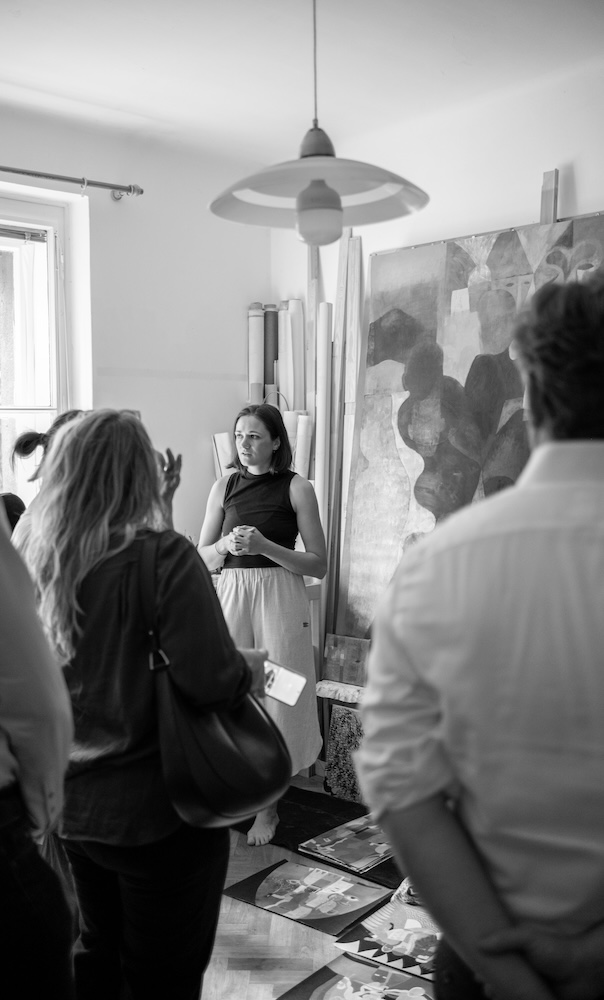
Become part of Art Part Club
Art Part Club is a space for inspiration, education, sharing and buying art. Join a community of people who are curious about the art world and want to get to know it up close.
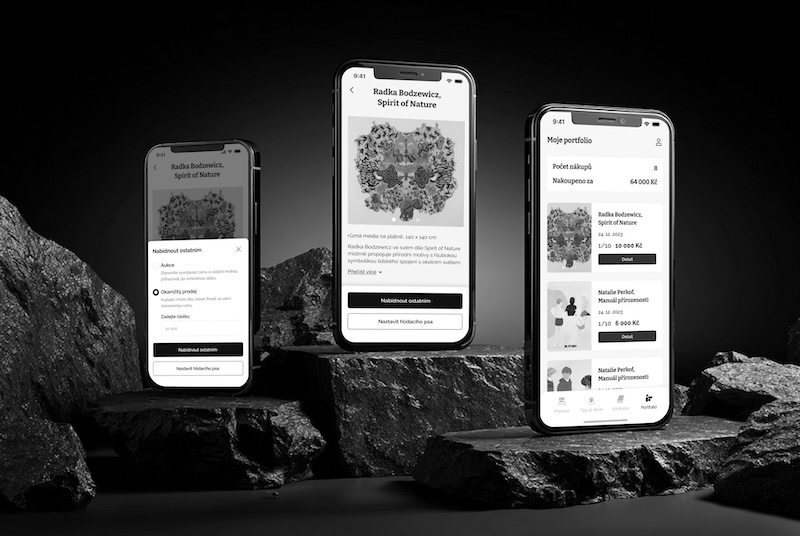
Download the ArtPartClub app