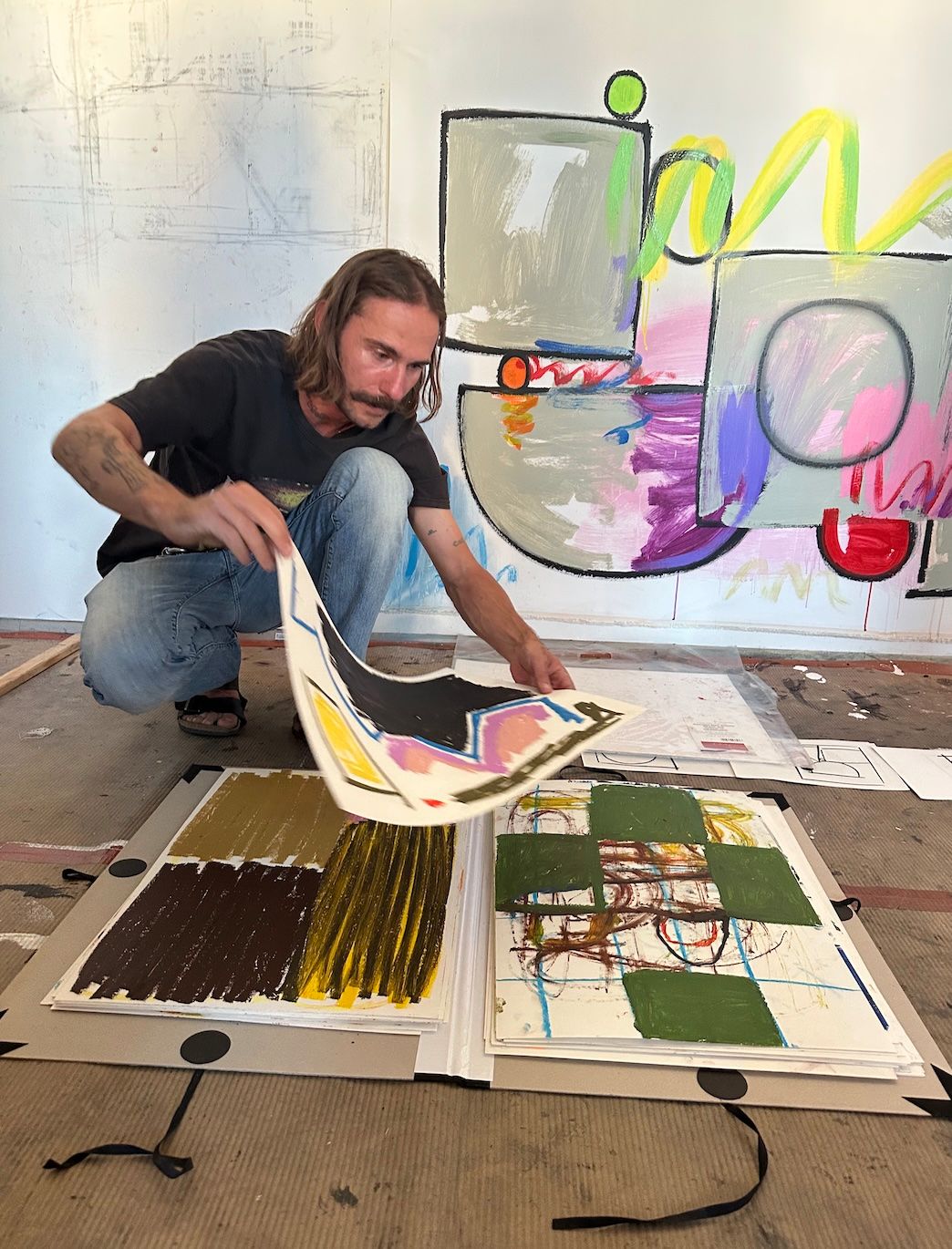
Rectangles, stripes and colour fields on two-metre canvases. At first glance, pure geometry of the kind you know from Modernist textbooks. Yet these paintings were not made with a ruler. The painter creates them by intuition, with spray paint and oil pastel, and behind them stands not a manifesto but a question: what does utopia look like in an age when we no longer believe in utopias? David Krňanský (b. 1987) is a Prague painter who combines geometric abstraction and the principles of Constructivism with the theme of crisis and transience. Let us look at why he is worth following.
David Krňanský was born in Prague. He came to art by a detour through performance. From 2010 to 2011 he studied in the studio of Jiří Kovanda at the Faculty of Art and Design in Ústí nad Labem, that is, with one of the icons of Czech action and conceptual art. He then moved to the Academy of Arts, Architecture and Design in Prague (UMPRUM), to the painting studio of Jiří Černický and Marek Meduna, where he graduated in 2017. Since then he has devoted himself mainly to painting.
While still a student, he co-founded the group Black Hole Generation (BHG) with fellow students Julius Reichel and Martin Lukáč. The group responded critically to the shortcomings of the art scene of the day and quickly moved from collective painting to objects, installations and video that reflected the overload of the internet. BHG exhibitions took place in Prague, London and Warsaw. The group helped young painters gain visibility and a path abroad. But as Krňanský later admitted in an interview for the Olomouc-based Telegraph, running projects gradually drew them away from their own painting. So he returned to it.
If you look at David Krňanský’s paintings up close, you will see that the geometry here is not cold. He paints in acrylic and oil, but also adds oil pastels (greasy coloured crayons that leave a bold, tactile mark), graffiti spray paint or charcoal. He works on cotton canvas, though jute is not unfamiliar to him either. The formats are generous, often around two metres. Alongside the large canvases he is making an extensive series of oil pastel drawings on A4 paper titled THIS SIDE UP.
The result is a composition on a monochrome background, where colour fields and stripes create a rhythm but the painter’s hand remains visible. No machine-like perfection. Rather a Modernist structure that has passed through today’s world. In her annotation of his work for the Artlist database, Romana Veselá writes that Krňanský builds on Modernist visuality but combines it with an abstract present. Modernity remains an inspiration for him, though today more as a utopia.
Try it for yourself next time. Stand in front of his painting first at a distance and let the whole, the rhythm of the stripes and colour fields, work on you. Then step closer, until you see the trace of the pastel, the fine mist of spray and the places where the painter has painted over a layer. Only from that distance will you realise that beneath the strict geometry there pulses a quite human search.
What do you actually read in his paintings? For a long time David Krňanský has been exploring the colour spectrum and its disappearance into black and white. Colours decompose, vanish and reappear. He works with the principles of Constructivism (an avant-garde movement of the 1920s that built the picture from pure geometric elements) and with the theme of crisis, which has accompanied him for a long time.
His earlier works were more playful and drew more on the symbols of the internet age. Around 2011 to 2013 a smiley appeared as a sign of empty, anonymous emotion. The series NOT DEF worked with the empty rectangles that appear on a screen when a font is missing. A small sign of the impossibility of communication. The exhibition Sedmiruký kouzelník at Futura in Prague (2015) then explored collective memory and the sharing of content on social media.
Today his painting is quieter and more abstract. But try pausing in front of it. Why is the colour disappearing? Is it the fatigue of our age, or on the contrary a longing for order amid chaos? And how many colours do you still see when you switch the world around you to black and white?
A key chapter of recent years was the exhibition Garden at the HYB4 gallery in Kampus Hybernská in Prague (2023, curated by Michal Štochl), part of the Prague Art Week programme. The motif was the garden, a place that, according to the accompanying text, “accumulates space for cultivation and creativity”. When you tend a garden, it offers rest and order. Once you withdraw the care, harmony turns into chaos. With his palette Krňanský spoke metaphorically here about transience, the future of painting and the social status of the individual.
The painter himself speaks of his work sparingly. In the interview for Telegraph he said that he does not make projects but paints pictures, and that intuition is the most important key for him. He follows an inner compass and believes that a painting carries its message by itself. In his view it resonates best in the clean space of a white cube gallery (a neutral white exhibition room). The paintings from 2024 and 2025, large-format compositions in acrylic, oil and oil pastel, show that the compass points ever deeper into abstraction.
David Krňanský has exhibited in the Czech Republic and abroad. He has had solo exhibitions at the Prague galleries Jelení, SPZ, Futura and Berlínskej model, in 2017 at Galerie Leto in Warsaw, and together with Martin Lukáč at Ivan Gallery in Bucharest (2016 to 2017). His paintings have also appeared at the Prague gallery Hunt Kastner, at the Plzeň City Gallery and at the House of Arts of the City of Brno. He spent the winter of 2022 to 2023 on a residency at the Olomouc-based Telegraph and spends part of the year in Athens.
His works are in the collections of Fait Gallery, Adam Gallery, the Havrlant Art Collection, the Emmanuel Hervé Art Collection and in private collections in England, the USA and Poland. That is a strong signal: both institutions and collectors who follow contemporary abstraction are interested in his painting. Krňanský also likes to connect art with design. He collaborated on Ferdinand socks and on a bicycle with the brands Repete and Breadfit. The line between art and design is, in his view, really thin.
If you are heading to Prague, follow the programme of contemporary art galleries and take a close look at David Krňanský’s large canvases. You will see that even pure geometry can have a hand, a mood and a story of its own. The more art around us, the richer life is.
David Krňanský (b. 1987 in Prague) is a Czech painter, a graduate of the painting studio of Jiří Černický and Marek Meduna at UMPRUM in Prague, who previously studied with Jiří Kovanda in Ústí nad Labem. He is a co-founder of the art group Black Hole Generation. He works in geometric abstraction.
David Krňanský paints in acrylic and oil and adds oil pastels, graffiti spray paint or charcoal, often on large-format canvases of around two metres. He also makes oil pastel drawings on paper, for example the extensive series THIS SIDE UP.
David Krňanský explores the colour spectrum and its disappearance into black and white, geometric abstraction, the principles of Constructivism and the theme of crisis. For him Modernism is an inspiring, if today rather utopian, source. The exhibition Garden worked with the metaphor of the garden as order and chaos.
David Krňanský has exhibited at the Prague galleries Futura, SPZ, Jelení, Berlínskej model and Hunt Kastner, at the Plzeň City Gallery, at the House of Arts of the City of Brno, and in Warsaw, Bucharest and London. His works are in the collections of Fait Gallery and the Havrlant Art Collection, among others. He is also part of the Art Part Club curated selection.
No awards are listed for David Krňanský in publicly available sources. His position on the scene is shown rather by solo exhibitions in institutions and galleries and by representation in the collections of Fait Gallery, Adam Gallery and the Havrlant Art Collection.
David Krňanský belongs to a generation of painters who give geometric abstraction a new, personal hand, and Czech and international collections are interested in his paintings. His large-format canvases combine the Modernist tradition with the mood of today.
David Krňanský (also David Krnansky), 1987, Prague. Painter, lives and works in Prague. Studies: Faculty of Art and Design, Jan Evangelista Purkyně University, Ústí nad Labem, performance studio of Jiří Kovanda (2010 to 2011); Academy of Arts, Architecture and Design in Prague, painting studio of Jiří Černický and Marek Meduna (2011 to 2017). Residency: Telegraph, Olomouc (2022 to 2023). Group: co-founder of Black Hole Generation (BHG) with Julius Reichel and Martin Lukáč. Solo exhibitions (selection): Barevné léto, Galerie Jelení, Prague (2013); Showroom, Galerie SPZ, Prague (2014); Sedmiruký kouzelník, Futura, Prague (2015); Everything is Nice / Bon Appétit (with Martin Lukáč), Ivan Gallery, Bucharest (2016 to 2017); David Krňanský, Galerie Leto, Warsaw (2017); Garden, HYB4 Galerie, Kampus Hybernská, Prague (2023). Group exhibitions (selection): The Best Taylor in Town, Hunt Kastner, Prague (2015); VII. Zlín Salon of Young Artists, Zlín (2015); Smart Generation, Galerie NTK, Prague (2015); BHG: The Kings Are Back, The Dot Project, London (2016); Pure Hate, Nevan Contempo, Prague (2016 to 2017). Collections: Fait Gallery; Adam Gallery; Havrlant Art Collection; Emmanuel Hervé Art Collection; private collections in England, the USA and Poland. Technique: acrylic, oil, oil pastel, graffiti spray, charcoal on canvas; oil pastel drawing.
