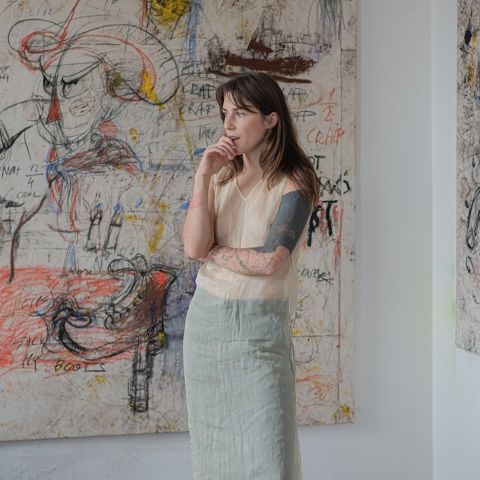
A cartoon character of the kind you know from children’s fairy tales, and right next to it a tank. The print of a shoe sole across the whole canvas, an inscription that sends a chill down your spine, and with it joyful, almost childlike colour. Ester Parasková (b. 1993) is a painter who joins the carefree world of childhood with the heavy themes of adulthood: commerce, globalisation, violence and oppression. According to Forbes her studio has long been sold out, and collectors at home and abroad want her paintings. Let us look at why she is among the most distinctive voices in contemporary Czech art.
Ester Parasková’s path to painting was not a straight one. She completed a secondary nursing school and then the Faculty of Education in Brno, in art and civic education. She originally wanted to tell stories through film or literature. In the end, however, she discovered that she tells them best through images. The sale of one of her first works encouraged her to head to Prague and enrol at the Academy of Arts, Architecture and Design (UMPRUM). She began in the painting studio, also passed through the intermedia studio and continued in fine art.
Working in a car factory was also a formative experience. According to the accompanying text for her Salzburg exhibition, the notion of work became a central motif of her output. During her studies she lived in a former dormitory where, as she told me in the podcast, she “kept creating furiously”. It was there that a then unknown collector visited her and offered her long-term support. Patronage in the twenty-first century? Yes, it exists. And Ester Parasková is proof that it can change a life.
On Ester Parasková’s canvases you will see a struggle between chaos and order. She paints mainly in oil and mixed media on large-format canvases, often around two metres. She combines a loose painterly gesture with precise, elaborate drawing. She works with a strong contrast of light and dark. She also reaches for charcoal, acrylic spray or a drawing on a piece of cardboard box, which she then frames under museum glass.
The studio itself becomes part of the painting. Dust, pigments and prints of hands and shoes remain on the canvas as an organic part of it. The act of painting thus merges with the environment in which it is made. She also explores the boundary between painting and drawing, childlike visuality and automatic writing (a spontaneous record of thoughts without conscious control, a technique made famous by the Surrealists). At first glance the result may seem naive. Galleria Doris Ghetta, after all, tongue in cheek, titled her exhibition in Ortisei, Italy (2021) Bad Paintings. Behind the apparent lack of skill, though, lies very carefully considered work.
Notice how she works with light. Dark areas from which bright colours emerge recall a theatre stage where the spotlight picks out only the essential. The drawing then guides the eye like a director. The longer you look, the more layers you discover: a crossed-out word, a repainted figure, a mark that should not have been there and yet remained. The strength of her paintings lies precisely in those imperfections.
How should you read her paintings? Ester Parasková deliberately mixes what we perceive as “high” and “low” art. Disney-like characters find themselves next to tanks, bullets and weapons. Titles such as Capitalism needs Poverty, Hands made for working, Tribe Against Tribe or No Man’s Land to Wasteland speak for themselves. For her, art is a political instrument meant to provoke emotion and raise questions. According to the text for the exhibition Fugazi, she does not criticise reality but mirrors it raw and unfiltered.
Her paintings work like a storyboard (a series of drawings that precede shooting in film). They show a few moments and leave the rest of the story to you. Try it for yourself next time. Find a character you know from childhood on the canvas, and then look around at what is happening near it. Why is it smiling? And who is actually threatening whom here?
Today Ester Parasková lives split between Greece and the Czech Republic. The last few years have been exceptionally intense for her. In 2024 she presented the exhibition SUCK at Galerie 1 in Prague, reflecting the last five years of her work, with new canvases made to suit the gallery space. In the same year her work appeared in the exhibition of contemporary Czech art New Era at the Czech embassy in Canberra, Australia. In 2025 she had a solo exhibition at Strom Art Gallery in Brno (West Scum) and, in the autumn of the same year, at Elektrohalle Rhomberg in Salzburg (Fugazi) with entirely new works. In 2026 an exhibition follows at Galerie Pekelné sáně in Kroměříž.
The paintings from 2024 and 2025 show that her world is expanding. Alongside tanks and weapons, workers’ hands, tools, houses built with one’s own hands and questions of home and identity appear. Family House, West is Left, Win your new homeland. Painting about where we belong.
Ester Parasková has exhibited in Prague, Brno, Italy, Austria and Australia, including at Galerie 1, Strom Art Gallery, Galleria Doris Ghetta, FIN Gallery in Victoria (European Summer, 2023) and Elektrohalle Rhomberg in Salzburg. More and more Czech and international collectors are buying her work, and according to Forbes her studio has long been sold out.
In the Forbes Life! podcast, Ester and I talked about patronage, about the differences between Czech and foreign collectors, about inspiration from film, literature and music, and about how motherhood has changed her work. When I asked her what success means to her, she answered simply: “Success is being a free person.” I also show her expressive gestural painting in my lectures on investing in art. The combination of strong content, a distinctive hand and growing international interest is exactly what deserves attention.
If you are planning a trip to Moravia, stop by Galerie Pekelné sáně in Kroměříž, and if you are in Prague or Brno, follow the programme of the galleries where Ester exhibits. Take a good look at the bottom of the painting too: you may find the print of her shoe there. The more art around us, the richer life is.
Ester Parasková (b. 1993) is a Czech painter who, after studying education in Brno, graduated from the Academy of Arts, Architecture and Design in Prague. She lives between Greece and the Czech Republic. Her expressive paintings join the world of childhood with the heavy themes of adulthood, and collectors in the Czech Republic and abroad collect them.
Ester Parasková paints mainly in oil and mixed media on large-format canvases, and also uses charcoal, acrylic spray and drawing on cardboard. She combines a loose gesture with precise drawing and leaves prints of hands and shoes, dust and pigments from the studio on the canvas.
Ester Parasková mixes high and low art, placing Disney-like characters beside tanks and unsettling inscriptions. She deals with commerce, globalisation, violence, oppression and the work she came to know in a car factory. Her newer paintings open questions of home and identity.
Ester Parasková has exhibited at Galerie 1 in Prague, at Strom Art Gallery in Brno, at Galleria Doris Ghetta in Italy, at Elektrohalle Rhomberg in Salzburg and in Australia. In 2026 she exhibits at Galerie Pekelné sáně in Kroměříž. She is also part of the Art Part Club curated selection.
Public sources do not list any awards for Ester Parasková. Her standing is shown rather by the long-term support of a patron, solo exhibitions abroad and the growing interest of Czech and international collectors.
Ester Parasková has a distinctive, instantly recognisable hand and the courage to open political themes. According to Forbes her studio has long been sold out, and solo exhibitions in Italy, Austria and Australia show growing international interest.
Ester Parasková, 1993. Painter, lives and works in Greece and the Czech Republic. Studies: secondary nursing school; Faculty of Education in Brno (art and civic education); Academy of Arts, Architecture and Design in Prague (painting studio, intermedia confrontation studio, fine art). Solo exhibitions (selection): Bad Paintings, Galleria Doris Ghetta, Ortisei, Italy (2021 to 2022); Gone to the Beach, Strom Art Gallery, Brno (2023); SUCK, Galerie 1, Prague (2024); West Scum, Strom Art Gallery, Brno (2025); Fugazi, Elektrohalle Rhomberg, Salzburg (2025); Galerie Pekelné sáně, Kroměříž (2026). Group exhibitions (selection): European Summer, FIN Gallery, Victoria, Australia (2023); New Era, Embassy of the Czech Republic, Canberra (2024). Technique: oil and mixed media on canvas, charcoal, acrylic spray, drawing, prints of hands and shoes.
