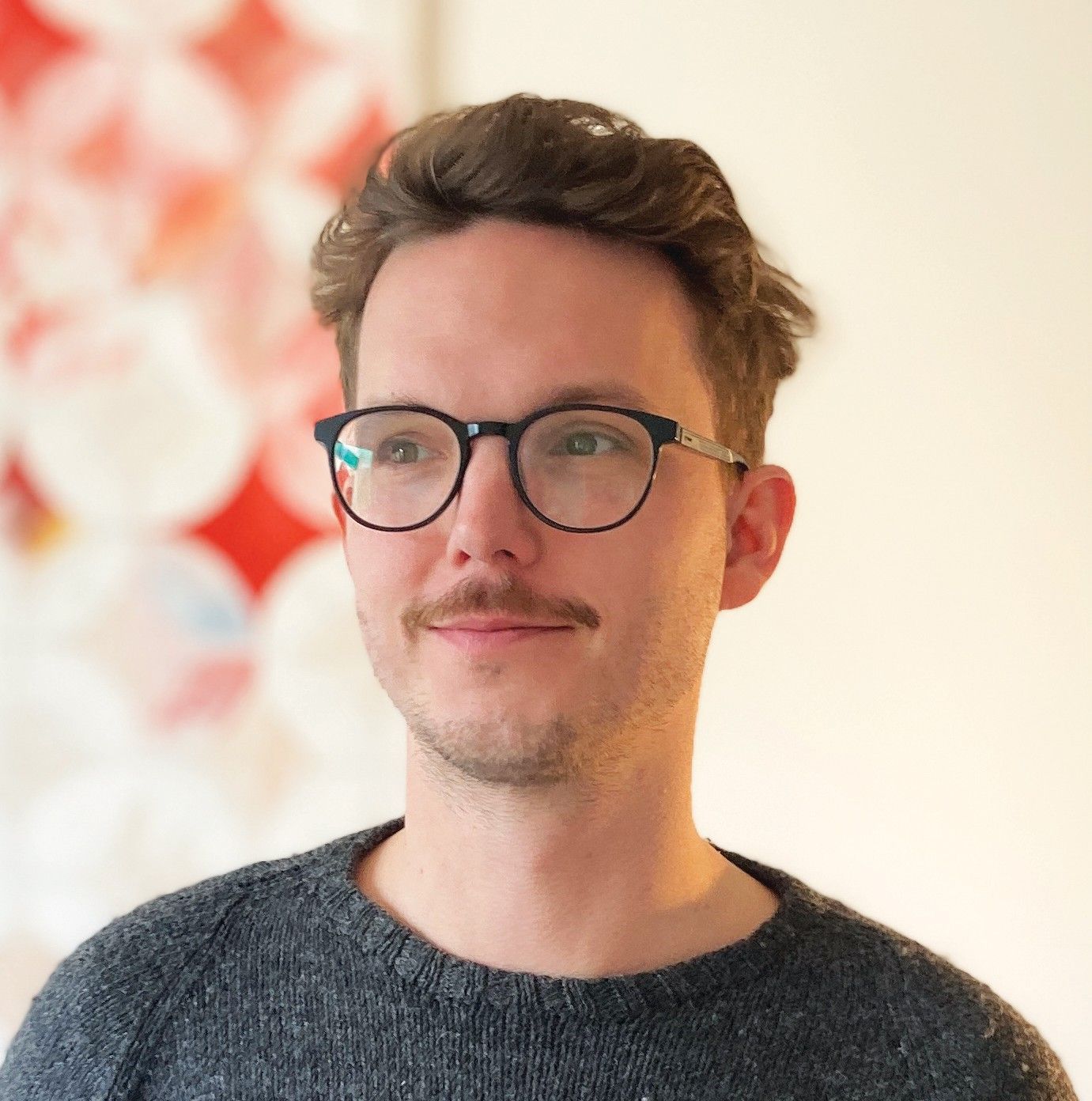
A Baroque scroll carved into orange polystyrene of the kind you know from insulating houses. A wooden panel with embossed copper that looks like an exhibit from a forgotten museum. A Romantic landscape with a moon and a clouded sky, painted without a grain of irony. Filip Dvořák (b. 1990) is a painter who long ago took painting out of its frame and turned it into objects, reliefs and entire stories. A laureate of both the Essl Art Award and the Critics’ Award for Young Painting, he is one of the most distinctive voices in contemporary Czech art. Let us look at why he is worth following.
From 2010 to 2015 Filip Dvořák studied in the painting studio of Jiří Černický and Marek Meduna at the Academy of Arts, Architecture and Design in Prague (UMPRUM). In 2012 he spent a study stay at the Glasgow School of Art in Scotland. Even during his studies he was testing where painting has its place in today’s world. One of his student projects was almost provocatively simple: on plastic cups and pieces of wood he painted the silhouette of Prague Castle with the word Prague in several languages and offered them to passers-by on Charles Bridge. Someone gave him a few coins, another a bottle of water, and another laughed at him. Painting as a souvenir? Painting as a commodity? A question that has stayed with him to this day.
Success came quickly. Right after graduating, in 2015, he won the Essl Art Award CEE, an award for young artists from Central and Eastern Europe. Among the works he presented in the final was an ironic video shot on 21 December 2012. That was the day the Maya calendar came to an end and the world was whispering about the predicted end of the world. The footage shows a painter braving frost and the elements on a mountain top at dawn. On doomsday itself, of course. In 2018 he won the 11th edition of the Critics’ Award for Young Painting, where he impressed the jury among eight finalists. He entered the competition with polystyrene panels with carved ornaments. Today he lives and works in Hejnice, below the Jizera Mountains.
Filip Dvořák studied painting, but he never submitted to the canvas. He works with wood, metal, polystyrene, ceramics, porcelain and beeswax. He makes collages, assemblages (spatial compositions from found and diverse objects), objects, video projections and actions in public space. For many of his works he came up with the term object-paintings: works that are both a painting and an object at once.
His early object-paintings took the form of theatrically lit assemblages made of waste (he used to work as a lighting technician in a theatre, after all). Then came the famous series of extruded polystyrene into which he carved Baroque scrolls (undulating plant ornaments typical of Baroque decoration). Czech Radio Vltava described the exhibition Barva soumraku at the Die Aktualität des Schönen gallery in Liberec (2016) as “post-apocalyptic Baroque”. A cheap building material and a lofty historical ornament. A mismatched pairing that works precisely because of its tension.
In recent years he has reached more for nobler materials. To the canvas he adds glazed ceramics, porcelain and copper, and works with printing ink and stitched canvas. He chooses each material for its symbolic meaning, not merely for effect.
What attracts Filip Dvořák most about art history? The periods when art had a deep spiritual role. For Czech Radio Vltava he described how he picks from history works that touch “something deep and spiritual”. He then sets them in contrast and in harmony with contemporary materials and aesthetics. He is interested in the energy that arises from such an encounter.
Ornaments, reliefs, architectural fragments, Gothic ruins, forests, horizons and sunsets recur in his work. At the exhibition Hora a mrak at Galerie Kaple in Valašské Meziříčí (2020) he combined impasto gestural painting (applied in thick, sculptural layers) with the outlines of ruins and illusionistic painting. The curator Martin Dostál wrote of his work that he seeks aesthetic and meaningful fragments of a past in which ornament was a matter of course and a painter could paint a moon and a clouded sky without hesitation.
Before his paintings, try asking yourself: why do we hesitate today to paint a sunset? Are we afraid of kitsch? And is the melancholic beauty that Dvořák unashamedly returns to galleries not precisely what we are missing?
Since 2020 Filip Dvořák has been developing the extensive cycle Strž, for which he also wrote a short story of the same name. It tells of a community of people trapped in a ravine created by a landslide. They tend a tree and hope that when it grows to the edge, they will climb out along it. Their views of the world often clash. It is a story of waiting, patience, faith and hope. Perhaps in spring, perhaps in a year.
The cycle is gradually growing into an entire imaginary world. The exhibition Strž at Luxfer Gallery in Česká Skalice (2020) brought romanticised landscapes of the ravine and paintings of the tree as a symbol of growing hope. It was followed by Ravine Culture at the Prague gallery Berlínskej model (2021) and Ve strži a jiné příběhy at GAVU Cheb (2022). At the exhibition The Ravine: The Room at Fait Gallery PREVIEW in Brno (2023, curated by Michal Stolárik), the view narrowed to fragments of a single room belonging to an unknown hero. Hanging wooden panels with embossed copper seemed like fictional readymades (ordinary objects elevated to the status of an artwork) and museum reconstructions of things that may once have served some purpose. Ornament gave way to strict geometry and square patterns. Here Dvořák moves somewhere between Art Nouveau, Josef Hoffmann and Charles Rennie Mackintosh (architects and designers from the turn of the 19th and 20th centuries who turned ornament into pure geometry). His newest works from 2024 to 2025 include the limited series High Noon and Podzimní série.
Filip Dvořák has exhibited in the Czech Republic and abroad since 2011. Besides the exhibitions mentioned above, these have included Black Lantern at Stone Projects and Distant Light at Galerie SPZ (both Prague, 2019). According to Trafo Gallery, his works are in significant public and private collections at home and abroad. In 2026, the Regional Gallery Liberec and the Museum of Art and Design Benešov also acquired his paintings for their collections. One of his polystyrene works can be found, for example, in the Emblem hotel in Prague, for which he made two bespoke works.
Why follow him? Few in contemporary Czech painting connect craft, story and spirit so earnestly. The Essl Art Award and the Critics’ Award for Young Painting showed that experts see his path too. And his cycles, which grow into whole worlds, give collectors the chance to follow a single story across the years.
If you go on a trip to the Jizera Mountains, remember that below them paintings are made about hope that grows like a tree out of a ravine. And when you see them up close, let them draw you in. The more art around us, the richer life is.
Filip Dvořák (b. 1990) is a Czech painter and creator of object-paintings, a graduate of the painting studio of Jiří Černický and Marek Meduna at UMPRUM in Prague. He is a laureate of the Essl Art Award CEE (2015) and the Critics’ Award for Young Painting (2018). He lives and works in Hejnice, below the Jizera Mountains.
Filip Dvořák combines painting with wood, copper, extruded polystyrene, ceramics, porcelain and beeswax. He makes object-paintings, collages, assemblages, objects, video projections and actions in public space. His polystyrene panels with carved Baroque ornaments are well known.
Filip Dvořák draws on periods of art history when art had a deep spiritual role, and works with ornament, landscape, architectural fragments and sunsets. Since 2020 he has been developing the cycle Strž about a community trapped in a ravine that hopes to be saved by a growing tree. The themes of his work are hope, waiting, faith and transience.
Filip Dvořák has exhibited at Fait Gallery in Brno, at GAVU Cheb, at the Galerie kritiků, at Stone Projects and at Galerie SPZ in Prague, among others. His work can also be seen in the Emblem hotel in Prague. He is also part of the Art Part Club curated selection.
In 2015 Filip Dvořák won the Essl Art Award CEE for young artists from Central and Eastern Europe. In 2018 he won the 11th edition of the Critics’ Award for Young Painting.
Filip Dvořák distinctively connects painterly craft, story and a spiritual dimension, and his works are in significant public and private collections. His cycles grow into whole imaginary worlds, so collectors can follow a single story across the years.
Filip Dvořák, 1990. Painter and creator of object-paintings, lives and works in Hejnice. Studies: Academy of Arts, Architecture and Design in Prague, painting studio of Jiří Černický and Marek Meduna (2010 to 2015). Residencies and exchanges: Glasgow School of Art, Scotland (2012). Awards: Essl Art Award CEE (2015); Critics’ Award for Young Painting, 1st place (2018). Solo exhibitions (selection): Barva soumraku, Galerie Die Aktualität des Schönen, Liberec (2016); Black Lantern, Stone Projects, Prague (2019); Distant Light, Galerie SPZ, Prague (2019); Hora a mrak, Galerie Kaple, Valašské Meziříčí (2020); Strž, Luxfer Gallery, Česká Skalice (2020); Ravine Culture, Berlínskej model, Prague (2021); Ve strži a jiné příběhy, GAVU Cheb (2022); The Ravine: The Room, Fait Gallery PREVIEW, Brno (2023). Group exhibitions (selection): Critics’ Award for Young Painting, Galerie kritiků, Prague (2018); Tide of Softness, Pragovka Gallery, Prague (2021). Collections: public and private collections in the Czech Republic and abroad; Emblem Hotel, Prague. Technique: object-paintings, painting, assemblage, collage, wood, copper, polystyrene, ceramics, porcelain, beeswax, video.
