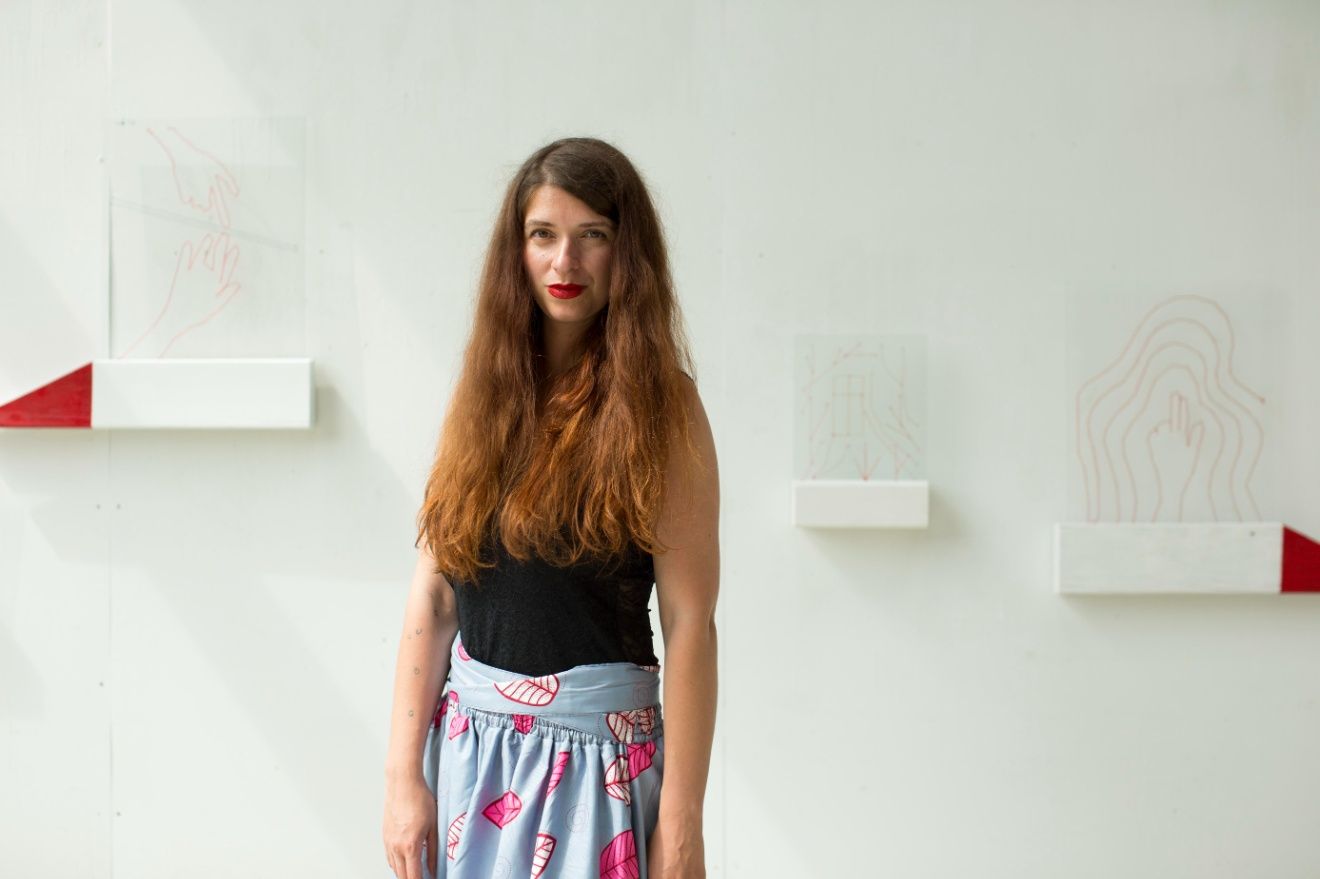
The needle passes through glass, a wooden beam and the skin of her own palm. Where most of us would expect fabric, Karíma Al-Mukhtarová (b. 1989) embroiders stories about what makes us who we are. A Prague artist with a Slovak mother and an Iraqi father, she is one of the distinctive names in contemporary Czech art: she combines embroidery, tapestry, ceramics and photo-performance in installations that ask about identity, roots and rituals. Let us take a look together at why she is worth following.
Karíma Al-Mukhtarová was born in Prague, but spent part of her childhood in Kutná Hora. Her path to art was not a straight one. She first studied at the Secondary School of Communication Technology in Prague, and only then joined the Faculty of Art and Design at Jan Evangelista Purkyně University in Ústí nad Labem, in the studios of Pavel Kopřiva and Jiří Kovanda. During her studies she went on an exchange to Kymenlaakso University of Applied Sciences in Kouvola, Finland. And what was her bachelor's thesis about? Myths and urban legends, which she explored experimentally and performatively (that is, through action and her own body, not only through images).
Then came UMPRUM in Prague and the studio of Jiří David, along with a placement in the sculpture studio of Kurt Gebauer. Around that time she also moved to Berlin, where she lived and worked for several years. She completed her studies at the Academy of Fine Arts in Prague: first in the monumental art studio of Jiří Příhoda, then in the intermedia studio (where different media are freely combined) of Milena Dopitová, under whose supervision she graduated. Three art universities, placements in Finland and with Kurt Gebauer, and years in Berlin. Few people have such a varied background.
Her early work was playful, experimental and gently ironic. She tested instructions from home physics, staged YouTube tutorials and examined where reality ends and fiction or a received idea begins. In her bachelor's project, for example, she literally looked for a needle in a haystack. At another point she built a levitating bookcase that rested on books. Sounds like a joke? It was precisely for these works that she won the prestigious Essl Art Award CEE in 2013, intended for young artists from Central and Eastern Europe. Hledání jehly v kupce sena (Looking for a Needle in a Haystack) had also become the title of her exhibition at Galerie Umakart in Brno a year earlier, in 2012.
Step by step she found her own way to traditional crafts, above all to embroidery. And she took it where nobody would expect it: onto glass, wood and human skin.
Embroidery is the hallmark of Karíma Al-Mukhtarová. She lifts it out of the traditional textile setting and embroiders into wooden beams, glass and her own skin. In doing so she explores what each material can bear, what it allows and where its limits lie. Each one calls for a different approach. Sheets of glass, for instance, she first drills by hand so that the thread can pass through at all. Try to imagine that patience. Embroidery becomes a way of entering the very structure of a material and changing its original character.
Alongside embroidery she makes tapestries (hand-woven wall textiles), ceramics, photographs and spatial installations. She likes to combine techniques and build complex wholes in which traditional craft meets a contemporary visual language. The process itself matters as much to her as the result: the time the work consumes and the physical contact with the material.
For centuries embroidery was associated mainly with domestic and women's work. In Karíma Al-Mukhtarová's hands it goes beyond decorative craft and takes on new meanings. She showed this as early as the exhibition Dear Valued Customers at the Prague City Gallery (2014 to 2015), curated by Monika Doležalová. In one installation she brought together a wooden beam with an embroidered plant motif, a burqa decorated with Arabic ornament and the sound of the Berlin metro. What do these things have in common? At first glance, nothing. At second glance, they open questions about cultural identity, stereotypes and how we interpret symbols from different cultural settings.
Embroidery was not just a technique linking the individual works. Its meaning shifted with the material, the cultural context and the way it was displayed. The same stitch, a different story.
The central theme of Karíma Al-Mukhtarová's work is identity: how it is shaped by cultural environment, family history and personal experience. She has long explored the relationship between individual and collective memory, cultural belonging and what society expects of us. At the exhibition The Rooms at Galerie Futura in Prague (2017 to 2018, curated by Michal Novotný) she worked with childhood memories and found objects. The installations asked how a personality is formed, what roles society assigns to us and how those expectations affect the way we see ourselves.
An important chapter has been Vodun, a traditional spiritual and religious system of West Africa. She gradually became familiar with its cultural and symbolic contexts during art residencies at CEAAC in Strasbourg and Art Omi in New York. She came to know it in depth during a stay at the Finnish-African cultural centre Villa Karo in Benin. “For me, Vodun means a connection with the wisdom of nature and with the people who lived before us,” she said in an interview for Forbes. In her works she then explored the relationship between spiritual traditions, nature, the body and cultural memory, as well as questions of otherness and the historical consequences of colonialism.
After returning from Benin she began to develop her practice more systematically, in the form of artistic research (inquiry that proceeds through making). She focuses mainly on hybrid identity, that is, an identity made up of several cultures at once. She currently works as an artist and artistic researcher in the doctoral programme at the Ladislav Sutnar Faculty of Design and Art at the University of West Bohemia in Plzeň. Her research project has a name you will remember: Sweet & Sour. In it she connects personal and cultural memory with botanical practice and the experimental breeding of tomatoes (crossing varieties to obtain new traits). She sees plants and their seeds as possible carriers of memory, heredity and cultural transmission. Can a tomato seed be an archive of family history? Karíma Al-Mukhtarová thus extends her long-standing exploration of identity with a biological and material dimension.
In spring 2024 Karíma Al-Mukhtarová spent the J&T Magnus Art residency in the Sparkasse palace in Karlovy Vary. She presented the works from Vary at Magnus Art gallery in early 2025, and her monumental tapestry on the changing symbolism of the bath (on the passage between death, acceptance and rebirth) travelled as far as London. At the exhibition They All Met in Karlsbad in the Vitrínka gallery of the Czech Centre (July to August 2025), it was joined by a sculpture by the artist TEA, which incorporated fragments of Karíma's tapestry. In the same year she also exhibited at Villa Pellé in Prague, where the new works revolved around the body. In her most recent exhibitions she showed glass layered in frames for the first time and incorporated a carpet tapestry into objects.
Karíma Al-Mukhtarová exhibits regularly at home and abroad. She has had solo shows at Jiri Svestka Gallery in Berlin (2016), Art Space NOV in Pardubice (2018), the Aleš South Bohemian Gallery in Hluboká nad Vltavou (2023) and Pragovka Gallery (First Principles, 2024). Pragovka is also where she has had her studio for many years. In group shows she has appeared, for example, at the Essl Museum in Klosterneuburg, Austria, at DSC galerie (Radikální ženy, 2020) and in the exhibition Vlákna, klubka, tkaniny in Jihlava (2017).
When I mentioned Karíma in my lecture Umění investovat do umění among the names worth following, I spoke about an artist who is not afraid of any material, not even embroidery into glass, and whose foreign roots give her a global dimension. She was at that moment on a placement in Africa, and I said we would hear a lot more about her. The London exhibition confirms it. In the overview of the most exhibited artists in the Czech Republic that I show in my lectures, you will also find her alongside names such as Josef Bolf, Eva Koťátková and Adam Štěch. She sells mostly privately, and by her own account collectors found her about five years ago. Textile and embroidery are, after all, among the notable trends of the current art market. They are long past being “handicrafts” and are a fully fledged medium.
If you are heading to Prague, follow the programme of Pragovka Gallery and see her works up close. You will see how the thread passes through glass, and you may start asking yourself which stitches the place you come from has left in you. The more art around us, the richer life is.
Karíma Al-Mukhtarová (b. 1989 in Prague) is a Czech visual artist and artistic researcher with a Slovak mother and an Iraqi father. She studied at the Faculty of Art and Design in Ústí nad Labem, at UMPRUM under Jiří David and at the Academy of Fine Arts in Prague, where she graduated under Milena Dopitová. Today she is in the doctoral programme at the Ladislav Sutnar Faculty of Design and Art at the University of West Bohemia in Plzeň.
Karíma Al-Mukhtarová takes embroidery onto unconventional materials: she embroiders into wooden beams, into glass, which she first drills by hand, and into her own skin. Alongside this she makes tapestries, ceramics, photographs and spatial installations, and she likes to combine techniques. The process itself and physical contact with the material matter greatly to her.
The central theme of Karíma Al-Mukhtarová's work is identity, in particular hybrid identity, and the relationship between individual and collective memory. She deals with West African Vodun, otherness and the consequences of colonialism. In her research project Sweet & Sour she connects memory with botanical practice and the experimental breeding of tomatoes.
Karíma Al-Mukhtarová has exhibited at the Prague City Gallery, Galerie Futura, the Aleš South Bohemian Gallery, Pragovka Gallery, where she has her studio, Magnus Art gallery, Villa Pellé and the Czech Centre in London, among others. She is also part of the curated selection at Art Part Club.
In 2013 Karíma Al-Mukhtarová won the Essl Art Award CEE for young artists from Central and Eastern Europe, for works from her bachelor's project, such as looking for a needle in a haystack and the levitating bookcase. As early as 2011 she received the studio prize in Jiří Kovanda's studio.
Karíma Al-Mukhtarová is among the most exhibited contemporary artists in the Czech Republic and has completed residencies in France, the USA, Benin and Karlovy Vary. Her work with embroidery on unconventional materials is unique on the Czech scene, and the artistic research in her doctoral programme takes her into a new, interdisciplinary territory.
Karíma Al-Mukhtarová (also Karíma Al-Mukhtar), 1989, Prague (part of her childhood in Kutná Hora). Visual artist and artistic researcher: embroidery, tapestry, ceramics, installation. Education: Secondary School of Communication Technology, Prague; Faculty of Art and Design, UJEP, Ústí nad Labem, studios of Pavel Kopřiva and Jiří Kovanda (2009 to 2012); UMPRUM Prague, studio of Jiří David (2012 to 2014); Academy of Fine Arts in Prague, monumental art studio of Jiří Příhoda and intermedia studio of Milena Dopitová, diploma (2014 to 2018); doctoral programme, Ladislav Sutnar Faculty of Design and Art, University of West Bohemia in Plzeň (research project Sweet & Sour). Placements and residencies: Kymenlaakso University of Applied Sciences, Kouvola, Finland (2011); sculpture studio of Kurt Gebauer; several years in Berlin; CEAAC, Strasbourg; Art Omi, New York; Villa Karo, Benin; J&T Magnus Art, Karlovy Vary (2024). Awards: Essl Art Award CEE (2013); studio prize of Jiří Kovanda's studio (2011). Solo exhibitions (selection): Hledání jehly v kupce sena, Galerie Umakart, Brno (2012); Dear Valued Customers, Prague City Gallery, Prague (2014 to 2015, curator Monika Doležalová); I don’t agree with myself, Jiri Svestka Gallery, Berlin (2016); The Rooms, Futura, Prague (2017 to 2018, curator Michal Novotný); Vnitřní pocit, Art Space NOV, Pardubice (2018); Aleš South Bohemian Gallery, Hluboká nad Vltavou (2023); First Principles, Pragovka Gallery, Prague (2024); Magnus Art, Prague (2025); Villa Pellé, Prague (2025). Group exhibitions (selection): Essl Museum, Klosterneuburg (2013); Vlákna, klubka, tkaniny, Jihlava (2017); Radikální ženy, DSC galerie, Prague (2020); They All Met in Karlsbad, Vitrínka gallery, Czech Centre London (2025). Technique: embroidery in glass, wood and skin, tapestry and carpet tapestry, glass layered in frames, ceramics, photography and photo-performance, spatial installations; artistic research with botanical practice.
