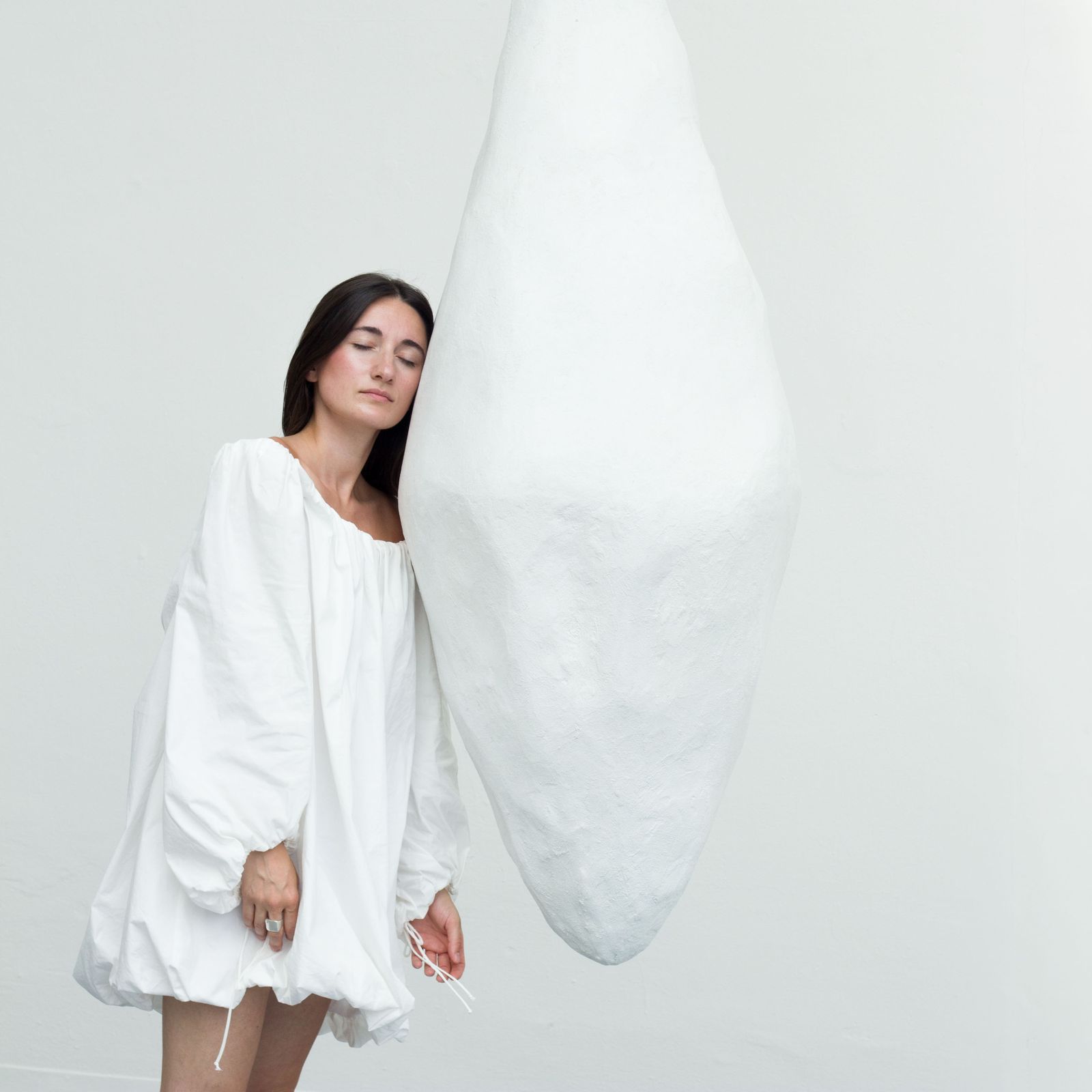
What does breath look like? Does it have a shape, a mass, a colour? The sculptor Kateřina Šťastná (b. 1996) has been asking this for several years, and she answers with plaster figures, marble reliefs and embroideries made of tens of thousands of glass beads. Her figures are rounded and simplified, as if shaped by the air that the body takes in and gives out. Her diploma work from the Academy of Fine Arts in Prague placed her in 2025 among the most closely watched names in contemporary Czech art. Let us look together at why she is worth following.
Kateřina Šťastná comes from Olomouc. She first approached art through the lens: she began by studying photography at the Faculty of Fine Arts of Brno University of Technology. Soon, however, she found that she was more drawn to matter, and she switched to sculpture. She completed her bachelor's studies in the studio of Michal Gabriel. As she recalls in an interview for Forbes, sculpture absorbed her completely.
She completed her master's studies at the Academy of Fine Arts in Prague (AVU) in the sculpture studio. She began with Lukáš Rittstein and finished with Tomáš Hlavina and Jimena Mendoza. During her studies she went on exchange to the Accademia di Belle Arti di Brera in Milan and to Tallinn, and took part in a ceramics symposium in Barcelona.
Kateřina Šťastná's range of materials is exceptionally wide. She models life-size plaster sculptures, makes marble reliefs and works with ceramics, stoneware, polyester resin and concrete. For her diploma sculptural group she used a mixture of limestone marble dust and white cement.
Then there is the second, intimate side of her work: embroidered pictures made of glass beads. She sews each bead on by hand, onto canvas, satin, chiffon or cotton. A single work can therefore contain tens of thousands of stitches. The result is shimmering surfaces that change with the light and resemble painting more than handwork.
Try it for yourself next time. Look at a bead embroidery first up close, where you will see the individual glass beads and stitches. Then step back a few paces and watch how thousands of tiny points come together into a figure, a shadow or a wave. It is a little like breath: we are not aware of individual breaths, but together they make up life.
One more technique is worth mentioning. For a series of paintings from 2024 she used pigment from mineral water, that is, deposits of minerals that she lets work their way into the fabric. Water, breath, body. Everything is connected.
The central theme of Kateřina Šťastná's work is the relationship between the body, air and environment, above all breath. “Breath, over time, became the essential source that gradually shaped the form of my work,” she says. She tries to capture how breath might look at the moment when the shape of the human body defines it. That is why her figures are stylised, rounded and free of unnecessary detail. They are not portraits of a particular person but rather a mass through which air passes.
The titles of her works express this well: Nádech, Výdech, Hmota dechu, Dýchám, cítím. Try pausing in front of them for a moment and following your own breath. Where do you feel it? In the chest, the belly, the shoulders? And how would it look if you could model it from clay?
Her diploma work Moje tělo vedle tvého (2025) moved the theme towards closeness and relationships. A pair of walking concrete figures, five textile embroideries made of tens of thousands of beads, and a central sculptural group of two figures joined by the backs of their hands. The work touches on the relationship between mother and daughter and the question of how to find a balance between care and personal space. The sculptural group was acquired by The House collection of the curator Kristýna Špringlová.
Until recently she pursued her work alongside a job. She taught in the Kreslírna studio and worked at Fait Gallery and in the design shop Ty Identity. In her words, her diploma brought a turning point. The work opened the door to the KC Editions programme of KodlContemporary gallery, and she began collaborating with Crag gallery in Turin. In autumn 2025 she exhibited at NIA Gallery in Prague and was part of the Czech participation in the Luxembourg biennial of arts and crafts De Mains De Maîtres. In 2024 she had already presented the exhibition Nuance vzduchu at Curator Contemporary (curator Bára Alex Kašparová), and she also had a solo exhibition at Galerie Stará radnice in Vsetín (Pomezí identity). In Košice, Slovakia, a bronze sculpture of hers stands in public space, designed for the company Telegrafia. Forbes also mentions a forthcoming solo exhibition at the König Vlk gallery in Brno, another stop on a journey that is only getting under way.
She is now working on a new series about sleeping positions, a lighter theme that already appears in the embroidery Usínání (2026). The latest high point so far was the solo exhibition Intervaly přítomnosti at Artium by KKCG in Prague (May to July 2026), a site-specific project that worked with the flow of people, light, greenery and acoustics. Visitors literally activated the installations with their movement, breath and closeness.
I was delighted to curate the exhibition Intervaly přítomnosti. In the centre of Artium hung a fabric capturing a body in water, swaying with the surrounding air; sculptures of dancing, merging bodies were lit by pulsating light; and on the water surface a sleeping figure was reflected, which you discovered only when you looked down. For me it is an exhibition about responsibility: about the ability to stop, to notice the world and other people, and to understand what trace we leave behind.
Why follow Kateřina Šťastná in particular? She combines sculptural monumentality with handwork that demands endless patience, and gives both a strong theme. A year after graduating she is in the private collection The House, works with KodlContemporary and a gallery in Turin, and thanks to sales can devote herself fully to her work. As she says herself, she is incredibly grateful for it.
If you are planning a trip to Prague, follow the programme of KodlContemporary and NIA Gallery, and look for her too in the exhibition of Lukáš Rittstein and his students at Portheimka, which Forbes announced for 2026. And when you stand before her sculpture, take a deep breath. The more art around us, the richer life is.
Kateřina Šťastná (b. 1996 in Olomouc) is a Czech sculptor and visual artist. After studying photography and sculpture at the Faculty of Fine Arts of Brno University of Technology, she graduated from the sculpture studio at AVU in Prague with the diploma work Moje tělo vedle tvého (2025), which was among the best student works of the year.
Kateřina Šťastná models sculptures from plaster, concrete and bronze, and makes marble reliefs, ceramics and objects from polyester resin. She also creates embroidered pictures from tens of thousands of glass beads and paintings with mineral water pigment.
Kateřina Šťastná's main theme is the relationship between the body, air and environment, above all breath. She tries to capture how breath might look when the shape of the human body defines it. She also explores closeness and relationships and, more recently, sleeping positions.
Kateřina Šťastná has exhibited at Artium by KKCG in Prague, at NIA Gallery, at Curator Contemporary and in Luxembourg, and her bronze sculpture stands in public space in Košice. She works with KodlContemporary and the Turin gallery Crag. She is also in the curated selection of Art Part Club.
No specific awards are listed for Kateřina Šťastná in public sources. However, her diploma work at AVU was counted among the best student works of 2025, and its sculptural group was acquired by The House collection.
Kateřina Šťastná combines sculptural monumentality with exceptionally patient handwork, and gives both a strong theme of breath and closeness. A year after graduating she works with KodlContemporary, exhibits abroad and her works are heading into private collections.
Kateřina Šťastná, 1996, Olomouc. Sculptor and visual artist. Studies: Faculty of Fine Arts, Brno University of Technology, photography, then sculpture (studio of Michal Gabriel); Academy of Fine Arts in Prague (AVU), sculpture studio (Lukáš Rittstein, Tomáš Hlavina and Jimena Mendoza), diploma work Moje tělo vedle tvého (2025). Exchanges and symposia: Accademia di Belle Arti di Brera, Milan; Tallinn; ceramics symposium, Barcelona. Solo exhibitions (selection): Pomezí identity, Galerie Stará radnice, Vsetín; Intervaly přítomnosti, Artium by KKCG, Prague (2026, curator Anna Pulkertová). Group exhibitions (selection): Nuance vzduchu (with Michal Pustějovský), Curator Contemporary, Prague (2024); NIA Gallery, Prague (2025); De Mains De Maîtres, Luxembourg (2025). Public space: bronze sculpture for the company Telegrafia, Košice. Collaborations: KodlContemporary (KC Editions); Crag gallery, Turin. Collections: The House (Kristýna Špringlová). Technique: plaster, marble, ceramics, concrete, bronze, polyester resin, glass bead embroidery, mineral water pigment.
