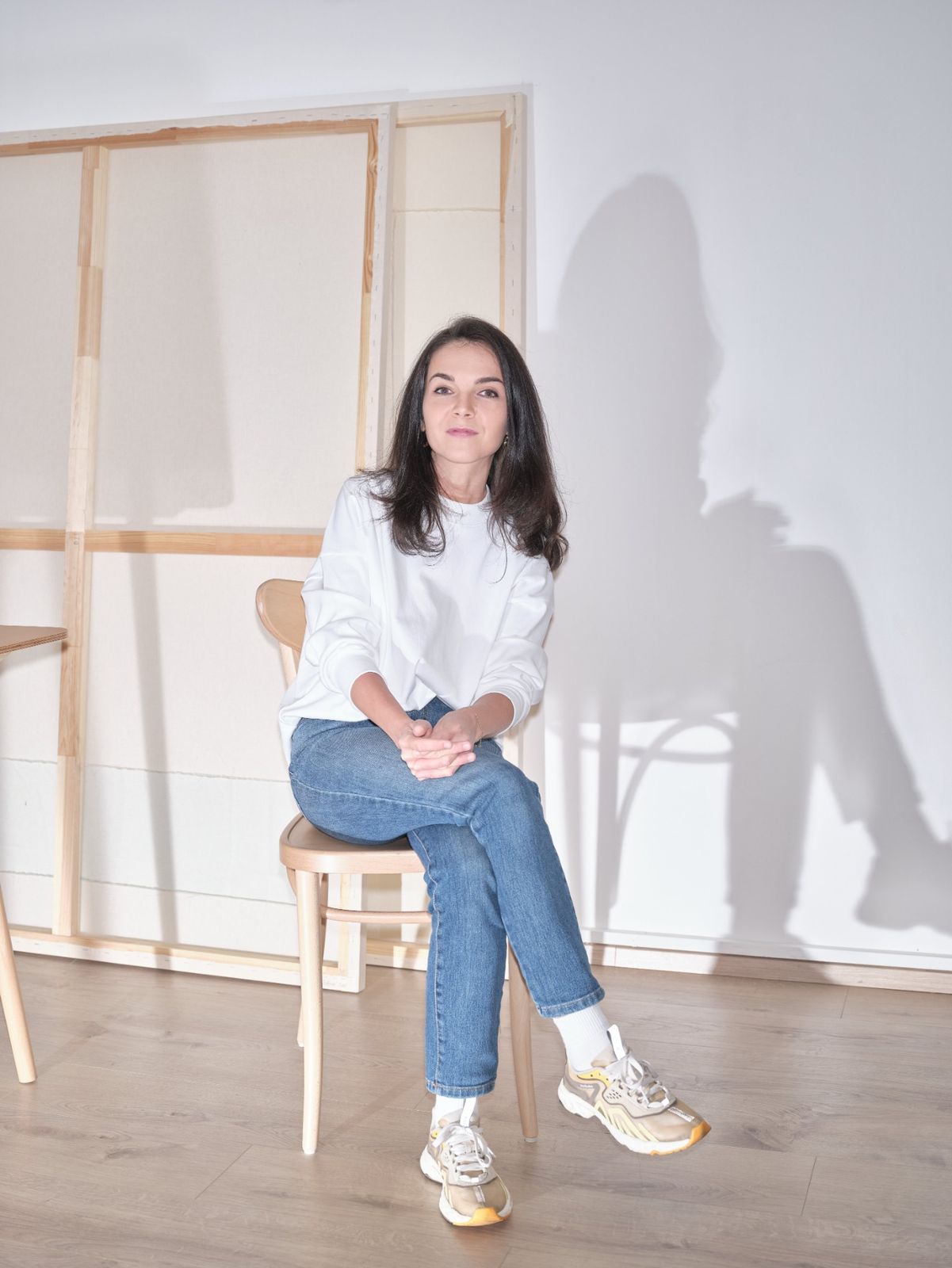
A painting without a single brushstroke. Just canvas, folded, crumpled and dyed so that a landscape of light and shadow rises from its folds. It looks like a relief, and yet it is a painting. Monika Žáková (b. 1987) is a painter who has set aside the painter’s tools and works with fabric, paper, metal and plaster much as a sculptor or an architect would. Her work is held in the Kunsthalle Praha collection and in Japanese collections. Let’s take a look together at why she is worth following.
Monika Žáková studied at the Academy of Fine Arts in Prague in the painting studio of Jiří Sopko, a distinctive colourist and one of the major figures of contemporary Czech art. She completed her studies in 2012 with her diploma work Linea Alba. During her studies she undertook study placements at the Hochschule für Bildende Künste in Dresden and in the studio of visiting professor Jan Merta at the Academy of Fine Arts.
Interestingly, she set off on an entirely different path from her teacher’s colourful figuration. She built on neo-constructivism and minimalism (art movements grounded in geometry, order and the most economical expression possible) and began exploring the boundary between painterly monochrome (a painting in a single colour) and low relief.
Success came early. In 2014 she took third place in the Critics' Award for Young Painting, one of the most closely watched competitions for painters under 35. In 2024 Czech Television devoted an episode of its series Talenty to her.
How does a painting without a brush come about? It starts with the material. Monika Žáková folds, crumples and dyes the canvas so as to accentuate its folds. Instead of brushstrokes, the drawing is done by light and by the shadow the folds of the fabric cast. The entries for her more recent works carry a brief description: cotton, acrylic on canvas.
Earlier she worked with sheet metal and aluminium, which she bent into illusory three-dimensional objects. Then came paper, which she explored, for example, in Bez názvu (B106) from 2018, now in the Kunsthalle Praha collection. She sprayed the paint onto the paper, so that the artist’s hand disappeared from the picture entirely. She had first folded the paper and only then stretched it onto canvas. From the dark lower sections, the picture gradually lightens upwards. Most recently she has also been making unique plaster casts, such as the Zero Gravity series.
Why would a painter want her own hand to disappear from the painting? Take a moment to think about it. A brushstroke is a signature, a gesture, the artist’s ego. When Monika Žáková removes it, only material and light remain. The painting then speaks not of who painted it, but of what you see. The accompanying text from Kunsthalle Praha connects this to the dissolution of material things described by the philosopher Franco Berardi in his theory of semiocapitalism (an economy in which signs, images and information carry the main value).
In my lectures on investing in art, I mention her as an artist who has been visible on the scene for some time: “It’s actually a very pure thing, working with very muted colours and the refraction of light.” The RMArt gallery puts it differently, but in a similar spirit: the result is geographic structures, and in the case of paper and fabric, true mind maps that emerge from the interplay between the artist and the material.
What will you see in Monika Žáková’s paintings? At first glance, calm. Monochrome surfaces, subtle transitions, muted colours. At second glance, movement. The folds ripple, the light refracts, the surface seems to breathe. Her works blur the line between flat and spatial representation, between painting and object.
Beneath the systematic, almost scientific approach there is also an emotional layer. Look at the titles of her series: Echoes of Fragility (2021), Soft Logic (2022), Echoes of Antifragility (2023–2024), Echoes of Memory (2025). Is crumpled fabric an image of vulnerability? Or, on the contrary, of a strength that straightens out again after being crumpled?
Try looking at one of her paintings from the side, and then from the front. Does the light change? Does a shadow appear that you didn’t see before? Her canvases change with the time of day, with the lighting of the room, with the spot you are looking from. Every view is a slightly different painting. And that is exactly why you never tire of such a work.
Notice the details, too. Some paintings are huge, more than 1.7 metres tall. Others are small, thirty by thirty centimetres. A large format envelops you; a small one draws you closer. Both work as a focused exercise in attention.
Monika Žáková has shown her work in solo and group exhibitions in a number of European capitals and in Japan. In 2016 she presented the exhibition Indian Space at Berlínskej model in Prague, and two years later Nová gravitace at Galerie Industra Art in Brno, curated by Tereza Jindrová. There she subjected metal and paper objects to similar processes and explored what happens to a picture hung on a wall.
In 2020 she had a solo exhibition, Ozvěny fragility, at the Gallery of Modern Art in Roudnice nad Labem, where she showed monochrome paintings, collages and three-dimensional aluminium objects. Solo exhibitions followed at Bold Gallery in Prague (2021) and, with Více světla, at the Aleš South Bohemian Gallery in Hluboká nad Vltavou (2023), curated by Jan Kudrna.
In recent years she has increasingly exhibited in Asia as well. At Double Q Gallery in Hong Kong she presented the exhibition Echoes of Time, Echoes of Memory in 2025, featuring two series of paintings of the same names in cotton and acrylic on canvas, and in 2026 she appeared there again in the exhibition UFO: Universal Futurological Organisation. In the Czech Republic, meanwhile, she has shown work in Summer Art Salon 2024 and POINT ZERO (2025) at KodlContemporary in Prague, Flashes of Time at Galerie Kvalitář (2025), CHATRNÝ 100 at the Gočár Gallery in Pardubice (2025) and Kabinet života at the Magnus Art Gallery of J&T Banka (2026).
Monika Žáková’s works are in the Kunsthalle Praha collection and, according to the RMArt gallery, in major Japanese collections as well. She is currently represented by Double Q Gallery in Hong Kong. In 2024, as I noted in my review of the first half of the year in art, she also did well at auction at Galerie Kodl, one of the most closely followed on the Czech market.
Together with Art Part Club members, we visited her in her studio. It is an experience that explains more than any description: you see how ordinary cotton fabric becomes a painting and how much patience lies behind every fold.
Why follow her? She has a clearly recognisable visual language, already acknowledged by the Critics' Award for Young Painting, and institutions and collectors at home and abroad are seeking out her works. Keep an eye on the programme of Double Q Gallery in Hong Kong as well as her exhibitions in the Czech Republic, and when you get the chance, look at her canvases up close and from the side. The more art around us, the richer our lives.
Monika Žáková (b. 1987) is a Czech painter and a graduate of Jiří Sopko’s painting studio at the Academy of Fine Arts in Prague. In 2014 she took third place in the Critics' Award for Young Painting, and she is currently represented by Double Q Gallery in Hong Kong.
Monika Žáková does not use a brush. She folds, crumples and dyes canvas so that the image is formed by folds, light and shadow. She also works with paper and spray paint, with aluminium and sheet metal, and with plaster casts.
Monika Žáková explores materials and the relationships between them, the boundary between painting and relief, between picture and object. She builds on minimalism and geometric abstraction, yet beneath her systematic approach lies an emotional layer of fragility and memory.
Works by Monika Žáková are in the Kunsthalle Praha collection and in Japanese collections. She has exhibited at Bold Gallery, the Aleš South Bohemian Gallery, the Gallery of Modern Art in Roudnice nad Labem and Galerie Industra Art. In recent years she has exhibited at Double Q Gallery in Hong Kong, KodlContemporary in Prague, Galerie Kvalitář, the Gočár Gallery in Pardubice and the Magnus Art Gallery of J&T Banka. She is also part of the Art Part Club curated selection.
In 2014 Monika Žáková took third place in the Critics' Award for Young Painting. Czech Television devoted an episode of its Talenty series to her (2024).
Monika Žáková has a clearly recognisable visual language in which light and shadow take the place of the brushstroke. Her works are held in institutional collections and collections abroad, and she has also done well at auction at Galerie Kodl.
Monika Žáková, 1987. Painter, lives and works in Prague. Education: Academy of Fine Arts in Prague, painting studio of Jiří Sopko (diploma 2012, Linea Alba). Study placements: Hochschule für Bildende Künste Dresden; studio of visiting professor Jan Merta, Academy of Fine Arts in Prague. Awards: 3rd place, Critics' Award for Young Painting (2014). Solo exhibitions (selection): Indian Space, Berlínskej model, Prague (2016); Nová gravitace, Galerie Industra Art, Brno (2018, curated by Tereza Jindrová); Ozvěny fragility, Gallery of Modern Art in Roudnice nad Labem (2020); Bold Gallery, Prague (2021); Více světla, Aleš South Bohemian Gallery, Hluboká nad Vltavou (2023, curated by Jan Kudrna); Echoes of Time, Echoes of Memory, Double Q Gallery, Hong Kong (2025). Selected exhibitions 2024 to 2026: UFO: Universal Futurological Organisation, Double Q Gallery, Hong Kong (2026); Kabinet života, Magnus Art Gallery of J&T Banka, Prague (2026); POINT ZERO, KodlContemporary, Prague (2025); Flashes of Time, Galerie Kvalitář, Prague (2025); CHATRNÝ 100, Gočár Gallery, Pardubice (2025); Summer Art Salon 2024, KodlContemporary, Prague (2024). Representation: Double Q Gallery, Hong Kong. Collections: Kunsthalle Praha; private collections in Japan. Media: ČT art, Talenty series (2024). Technique: cotton and acrylic on canvas (folded, crumpled and dyed canvas), spray paint on paper, aluminium and sheet metal, plaster casts.
