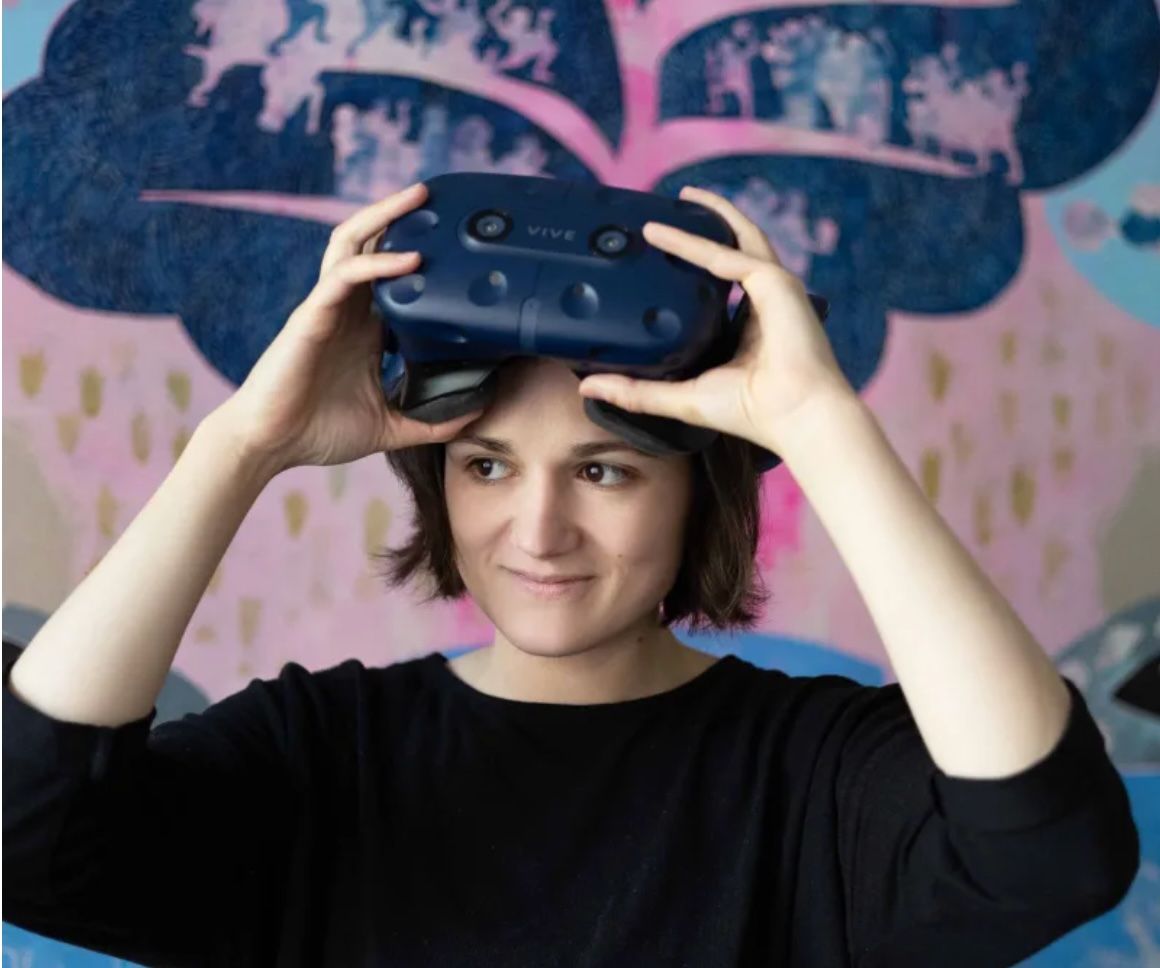
Point your phone at the canvas and the snake devouring its own tail begins to move. A picture that a second ago was a motionless oil painting suddenly breathes, sounds and opens another layer. Radka Bodzewicz (b. 1991) is a painter who combines large-format oil painting with augmented reality, virtual worlds and 3D printing. Yet she says of herself that she is above all a painter. Let us look together at why she is among the most interesting names in contemporary Czech art.
She comes from Šumperk. She studied at the Academy of Fine Arts in Prague (AVU), unconventionally in two studios that at first glance have nothing to do with painting: the printmaking studio of Vladimír Kokolia and the sculpture studio of Jindřich Zeithamml. She graduated in 2017. The year before, she spent a placement at Gray's School of Art at Robert Gordon University in Aberdeen, Scotland. In 2018 she was among the finalists of the prize of the Berlin foundation Leinemann-Stiftung für Bildung und Kunst.
Printmaking taught her patience with detail, sculpture taught her to think in space. Both can be felt in her pictures. Large wholes hide tiny details that recall medieval illuminations (hand-painted decoration of manuscripts). And what you see on the canvas often began as a spatial model.
Radka Bodzewicz paints mainly in oil on large-format canvases. A large space is, in her words, simpler, and the viewer can enter it more easily. Alongside this she draws in acrylic and ink and creates sculptural objects from 3D printing. But the most surprising thing comes when you pick up your mobile phone.
She began using augmented reality (AR, a digital layer that is projected through the phone over the real picture) in 2020. The pandemic then made it impossible for her to exhibit in virtual-reality headsets, so she looked for a way to bring the world she paints in virtual reality to viewers differently. The process is careful. First the picture is made, then a 3D model of it in virtual space, which her husband, a programmer, links to the canvas in an application. The phone then recognises the picture by its shapes and colours and brings it to life. The picture itself and its digital form often take a month, but easily half a year.
In the Forbes Life! podcast Radka described to me how such a virtual world begins: "In a virtual world, at first you are surrounded only by pitch-black darkness." Landscapes and figures then grow out of the darkness and finally return to the canvas. She has long been interested in technology, but she also perceives its limits. For her, painting always takes priority.
What do you actually see in her pictures? Figures that are not portraits. She sums it up in one sentence: "I make figurative abstractions, not a real depiction of a person." Hands and feet recur often. The hand means touch and safety, the foot the direction of life's path. The colours tend to be warm and radiant, with a hint of the Orient.
Radka Bodzewicz always reads several books at once, and literature is her main driving force. She is inspired by Dante's Divine Comedy, Milton's Paradise Lost, Jung's Red Book and Mircea Eliade's The Myth of the Eternal Return. She is interested in archetypes and the collective unconscious (the term of the psychologist Carl Gustav Jung for a shared layer of the human psyche from which myths and symbols grow). She is fascinated that she can bring to light something we all know without knowing that we know it.
A key symbol for her has become the ouroboros, the snake devouring its own tail. An ancient image of eternity, of beginning and end. Try pausing at her canvases and asking: where does life begin here and where does it end? What is conscious and what hides beneath the surface? The picture will not give you the answer. In our conversation she herself said that her own interpretation cannot be conveyed to the viewer. The picture is meant for the person. Everyone imprints their own story on it.
The largest chapter of her work so far is the cycle after Goethe's Faust. She took it on in autumn 2025 and in summer 2026 presented it at the DOX Centre for Contemporary Art in Prague (curator Michaela Šilpochová). Around twenty large-format canvases spread across three floors. On the first Mephisto reigns, clearly legible, at one moment in the form of a black dog, at another a jester. On the second lives Margarete and her tragic story, the figure partly dissolving into the landscape. And on the third floor is Faust, who has almost no recognisable features left. Besides the pictures you will also see the artist's diaries, planners and sketches.
For Radka Bodzewicz, Faust is a story about the desire for knowledge, love, power and fame. And about decisions that cannot be taken back. In an interview for the Kulturák podcast she said that, in her view, we make a pact with the devil every day, whenever we agree to something that does not match our convictions. How many such pacts have you signed?
Radka Bodzewicz has a series of solo exhibitions behind her. In 2022 she exhibited at Galerie Václava Špály in Prague (In illo tempore), in 2023 she opened BOLD Gallery in Holešovice with the exhibition Paradise Lost (curator Radek Wohlmuth), and in the same year she presented Mundus imaginalis at the Gallery of Fine Arts in Cheb. In 2025 she filled three floors of the U Jonáše house in Pardubice with the exhibition Uroboros (Gočár Gallery, curator Aneta Kopecká). She has also exhibited at UFFO in Trutnov and at the Signal light festival. In spring 2026 she worked at a residency at the International Artists' House in Schwandorf, Bavaria. Her pictures are in individual and institutional collections.
With Radka in the Forbes Life! podcast we talked about art and technology, about the unconscious, about artificial intelligence, but also about what children can teach us and how to find sacred moments in an ordinary day. The conversation showed how naturally she combines deep reading with the latest technologies. And yet she remains a painter who believes in the power of the canvas. I like to show her colourful painting in lectures on investing in art as well, among the names worth attention. Artists who can connect a traditional medium with the digital world attract the attention of institutions and of a new generation of collectors.
If you are heading to Prague, you can catch the exhibition Faust at DOX until 8 November 2026. Do not forget to take your phone with you and let the pictures move. The more art around us, the richer life is.
Radka Bodzewicz (b. 1991 in Šumperk) is a Czech painter and intermedia artist, a graduate of the Academy of Fine Arts in Prague from the studios of Vladimír Kokolia and Jindřich Zeithamml. She combines large-format oil painting with augmented reality, virtual worlds and 3D printing. She is one of the prominent names in contemporary Czech art.
Radka Bodzewicz paints mainly in oil on large-format canvases, draws in acrylic and ink and creates objects from 3D printing. Since 2020 she has added a layer of augmented reality to her pictures: when a phone is pointed at the picture, it begins to move and sound. She also works with painting in virtual reality, video and holographic pictures.
Radka Bodzewicz draws on myths, archetypes and the collective unconscious and is inspired by literature: for example Dante's Divine Comedy, Milton's Paradise Lost, Eliade, Jung and Goethe's Faust. She deals with the cycle of life and death, the conscious and the unconscious, and good and evil. She herself describes her painting as figurative abstraction.
The exhibition Radka Bodzewicz: Faust runs at DOX in Prague until 8 November 2026. Earlier she exhibited at Galerie Václava Špály, at BOLD Gallery, at the Gallery of Fine Arts in Cheb, at UFFO in Trutnov and at the Gočár Gallery in Pardubice. She is also part of the Art Part Club curated selection.
In 2018 Radka Bodzewicz was a finalist of the prize of the Berlin foundation Leinemann-Stiftung für Bildung und Kunst. In 2026 she received a scholarship for a residency at the International Artists' House in Schwandorf, Germany.
Radka Bodzewicz is one of few Czech painters who naturally combine classical oil painting with the latest technologies, and her works are in individual and institutional collections. Institutions such as DOX and the Gočár Gallery have prepared solo exhibitions for her, and her literary cycles are among the most coherent projects of young Czech painting.
Radka Bodzewicz, 1991, Šumperk. Painter and intermedia artist, lives and works in Prague. Studies: Academy of Fine Arts in Prague, printmaking studio (Vladimír Kokolia) and sculpture studio (Jindřich Zeithamml), graduated 2017. Residencies and placements: Gray's School of Art, Robert Gordon University, Aberdeen (2016); Internationales Künstlerhaus Schwandorf, Germany (2026, Villa Paula scholarship). Awards: finalist of the Leinemann-Stiftung für Bildung und Kunst prize, Berlin (2018). Solo exhibitions (selection): In illo tempore, Galerie Václava Špály, Prague (2022); Paradise Lost, BOLD Gallery, Prague (2023); Mundus imaginalis, Gallery of Fine Arts in Cheb (2023); Vpít do sebe mraky myšlenek a potichu hledat svůj chrám, UFFO, Trutnov; Uroboros, Gočár Gallery, U Jonáše house, Pardubice (2025); Faust, DOX, Prague (2026). Other presentations: Signal Festival, Prague. Technique: large-format oil painting, acrylic and ink, augmented reality (AR), painting in virtual reality, video, holographic pictures, 3D printing.
