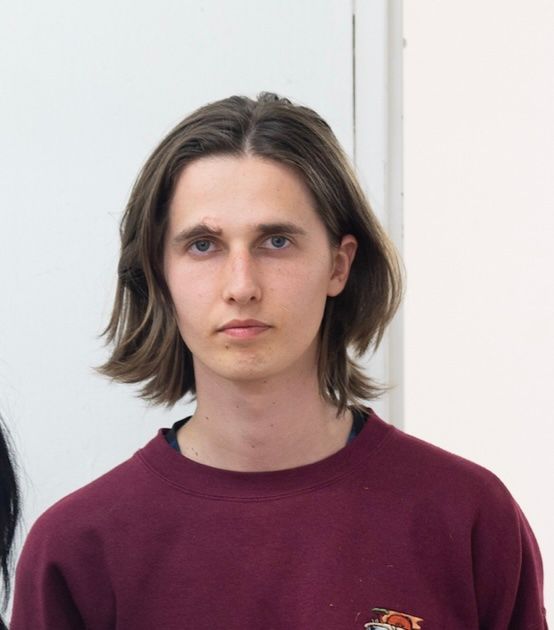
Imagine that in a million years someone digs up a piece of our age. What will they find? The imprint of a mobile phone in stone, fossilised resin, traces of cables and machines? The sculptor Stanislav Zábrodský (b. 1996) already makes such fossils today. From concrete, ceramics, resin and composite materials he simulates geological processes that take millions of years in nature, and lets us glimpse an "archaeology of the future". Let's look together at why he is worth following.
Stanislav Zábrodský comes from Opočno. From 2016 to 2022 he studied at the Academy of Fine Arts in Prague (AVU) in the Intermedia 3 studio of Professor Tomáš Vaněk. Part of his studies he spent in the sculpture studio at the Institut Seni Indonesia in Yogyakarta, Indonesia, where he met a completely different relationship to material and craft.
Fascination with stones has accompanied him for a long time. He is interested in mineralogy, the collecting of minerals and rocks, and the communities of people who collect, sort and admire stones. Why does a person long to own a piece of rock millions of years old? And what does a stone we hold in our palm tell us about time?
After graduating he quickly came to the attention of the scene. In 2023 he had a solo show at Lobster Space in Prague (Trouble’s Middle Name) and completed a residency with the Petrohradská collective. He also completed a J&T Magnus Art residency in Karlovy Vary, and in 2024 to 2025 he worked with Polansky Gallery, which ended its activity in January 2026.
The materials of Stanislav Zábrodský are not noble in the classical sense. He works with ceramics, concrete, resin, tin, wood and composite materials (mixtures of several substances that together create new properties, much like rocks in nature). He experiments with pigments and glazes (glassy coatings of ceramics that change the colour and the structure of the surface when fired).
His reliefs look like cut-outs from a rock face. The surfaces are cracked, layered, full of imprints. On closer look, though, you realise these are not natural fossils. There are traces of industrial production, technological shapes, digital echoes. For example, the pair of concrete reliefs Sundering Vale (2024) with a metal frame feels like an archaeological find from a distant, yet unsettlingly close civilisation.
Try it yourself next time. Stand in front of a relief by Stanislav Zábrodský and look for what belongs to nature and what to people. Where does sediment end and the trace of a machine begin? How many layers can you count? And what layer are we leaving behind?
The main theme of Stanislav Zábrodský is time. Not the linear kind that flows from the past into the future, but layered time, broken up, stored in material. In his view, materials record life much like fossils do. But his "fossils" are not natural relics. They are traces of human activity in the Anthropocene (a proposed geological epoch in which humans have become the main force transforming the planet).
Figuratively speaking, we already live inside future geological layers. Electronic waste, rare minerals mined for chips and industrial remains will one day become part of the Earth’s crust. Zábrodský thus speculates about how materials will change in the future and what will remain of us.
His work also has a strong theoretical background. The curator Livia Klein connects it with the ideas of the philosopher Jane Bennett about "vibrant matter", with Jussi Parikka’s "geology of media" and with the "speculative archaeology" of the historian Ewa Domańska. Do not worry, though, you do not need philosophy to experience the work. Curiosity is enough.
So far the largest solo exhibition of Stanislav Zábrodský was Rule of Thumb at Polansky Gallery in Prague (September to November 2025, curator Livia Klein). The title refers to the English saying for a rough, practical estimate, the opposite of scientific precision.
In the centre of the gallery hung a system of pseudo-pulleys and reliefs. Hourglass-shaped pulleys carried a rotating tin axis with sediment imprints and a pine counterweight that brought biological time into the work. Between them, "frozen" streams of resin recalled the famous Pitch Drop experiment at the University of Queensland (the longest-running laboratory experiment in the world, in which pitch has been slowly dripping for almost a hundred years). On the walls hung concrete and resin reliefs from the series Whim Flips Over (2025) with cracked surfaces, in which traces of vanished landscapes, industrial imprints and digital echoes mingled. The curator described them as an archive not of memory, but of persistence.
Still in November 2025, Polansky Gallery presented his work in the New Positions section at the Art Cologne fair, which is reserved for the emerging generation of artists.
And what did 2026 bring? Several important steps at once. In the gardens of Troja Château, the Prague City Gallery presented his outdoor work as part of the exhibition Labyrint: Krajina vnitřního bloudění. Try to picture it: fossils of the future under the open sky, next to a Baroque château. What does an old garden say about time, and what do his reliefs say?
In Wrocław he appeared in the exhibition No-Clip Dwelling as part of the KAF Young Art Prize 2026, organised by the Krupa Art Foundation. And with the Prague gallery Berlínskej model he travelled all the way to Hong Kong for the exhibition Symbiosis 3.0: Artificial Flavor. He also exhibited in Hauntology and the Never-Ending Presence at Fotograf Zone in Prague and in Beaune, France (Ground to Sky).
Stanislav Zábrodský has exhibited in the Czech Republic and abroad. In 2024 he had solo exhibitions This Is Not a Memoir at Polansky Gallery and TIME-DIP at Berlínskej model in Prague, and he appeared in exhibitions at IRL Gallery in New York (Ghost Dance), Plain Gallery in Milan (Against Interpretation) and ACUD Gallery in Berlin (Echoing Futures). In Prague he also exhibited at Holešovická šachta (Tendrils) and, in a duo with the painter Anna Ruth, at Studio PRÁM (Almost Time For a Bliss, 2024). In 2025 he took part in the exhibition The Landscape of Absence at MeetFactory, in the show Potkali se ve Varech at J&T Magnus Art gallery and in the SWAB fair in Barcelona.
Why follow him? He belongs to the youngest generation of sculptors who give material a new meaning. The themes of the Anthropocene, time and the traces we leave behind are exceptionally relevant today. And Art Cologne, the KAF Young Art Prize in Wrocław and the exhibition in Hong Kong show that his work is followed by the international scene too.
If you are planning a trip to Prague, follow his website and the programme of Berlínskej model, and see his reliefs up close. Perhaps afterwards you will pick up an ordinary stone at home and look at it differently. The more art around us, the richer life is.
Stanislav Zábrodský (b. 1996 in Opočno) is a Czech sculptor and intermedia artist, a graduate of Tomáš Vaněk’s Intermedia 3 studio at AVU in Prague, who also studied at ISI Yogyakarta in Indonesia. He makes "fossils of the future" from concrete, ceramics and resin.
Stanislav Zábrodský works with concrete, ceramics, resin, tin, wood and composite materials, and experiments with pigments and glazes. He uses composites as a synthetic simulation of geological processes that take millions of years in nature.
Stanislav Zábrodský deals with mineralogy, stone collecting, the perception of time and the Anthropocene. His works are a speculative archaeology of the future: they show traces of human and technological activity that will one day become part of geological layers.
In 2026 Stanislav Zábrodský showed an outdoor work in the gardens of Troja Château (GHMP, Labyrint: Krajina vnitřního bloudění), took part in the KAF Young Art Prize in Wrocław and exhibited with Berlínskej model in Hong Kong. Earlier he exhibited, for example, at Polansky Gallery, at MeetFactory, at the Art Cologne fair, and in New York, Berlin and Milan. He is also in the Art Part Club curated selection.
Stanislav Zábrodský appeared in 2022 as part of the Startpoint Prize showcase at HYB4 gallery in Prague and in 2026 exhibited as part of the KAF Young Art Prize in Wrocław. He also received a J&T Magnus Art residency.
Stanislav Zábrodský belongs to the youngest generation of sculptors who give material a new meaning, and his theme of time and the Anthropocene is exceptionally relevant. Taking part in the Art Cologne fair and the KAF Young Art Prize in Wrocław, and the exhibition in Hong Kong, show growing international interest.
Stanislav Zábrodský, 1996, Opočno. Sculptor and intermedia artist, lives and works in Prague. Studies: Academy of Fine Arts in Prague, Intermedia 3 studio, Prof. Tomáš Vaněk (2016 to 2022); Institut Seni Indonesia Yogyakarta, sculpture studio. Residencies: Petrohradská collective, Prague (2023); J&T Magnus Art, Karlovy Vary. Solo exhibitions (selection): Trouble’s Middle Name, Lobster Space, Prague (2023); TIME-DIP, Berlínskej model, Prague (2024); This Is Not a Memoir, Polansky Gallery, Prague (2024); Rule of Thumb, Polansky Gallery, Prague (2025). Group exhibitions and fairs (selection): Startpoint Prize, HYB4, Prague (2022); Eternal Maze, Jedna Dva Tři Gallery, Prague (2023); Ghost Dance, IRL Gallery, New York (2024); Against Interpretation, Plain Gallery, Milan (2024); Echoing Futures, ACUD Gallery, Berlin (2024); Tendrils, Holešovická šachta, Prague (2024); Almost Time For a Bliss (with Anna Ruth), Studio PRÁM, Prague (2024); The Landscape of Absence, MeetFactory, Prague (2025); Potkali se ve Varech, J&T Magnus Art (2025); SWAB Barcelona (2025); Art Cologne, New Positions, with Polansky Gallery (2025); Labyrint: Krajina vnitřního bloudění, GHMP, Troja Château, outdoor work (2026); No-Clip Dwelling, KAF Young Art Prize 2026, Krupa Art Foundation, Wrocław (2026); Symbiosis 3.0: Artificial Flavor, SATA, Hong Kong, with Berlínskej model (2026); Hauntology and the Never-Ending Presence, Fotograf Zone, Prague (2026); Ground to Sky, Terra, Beaune (2026). Technique: concrete, resin, ceramics, glazes, tin, wood, composite materials.
