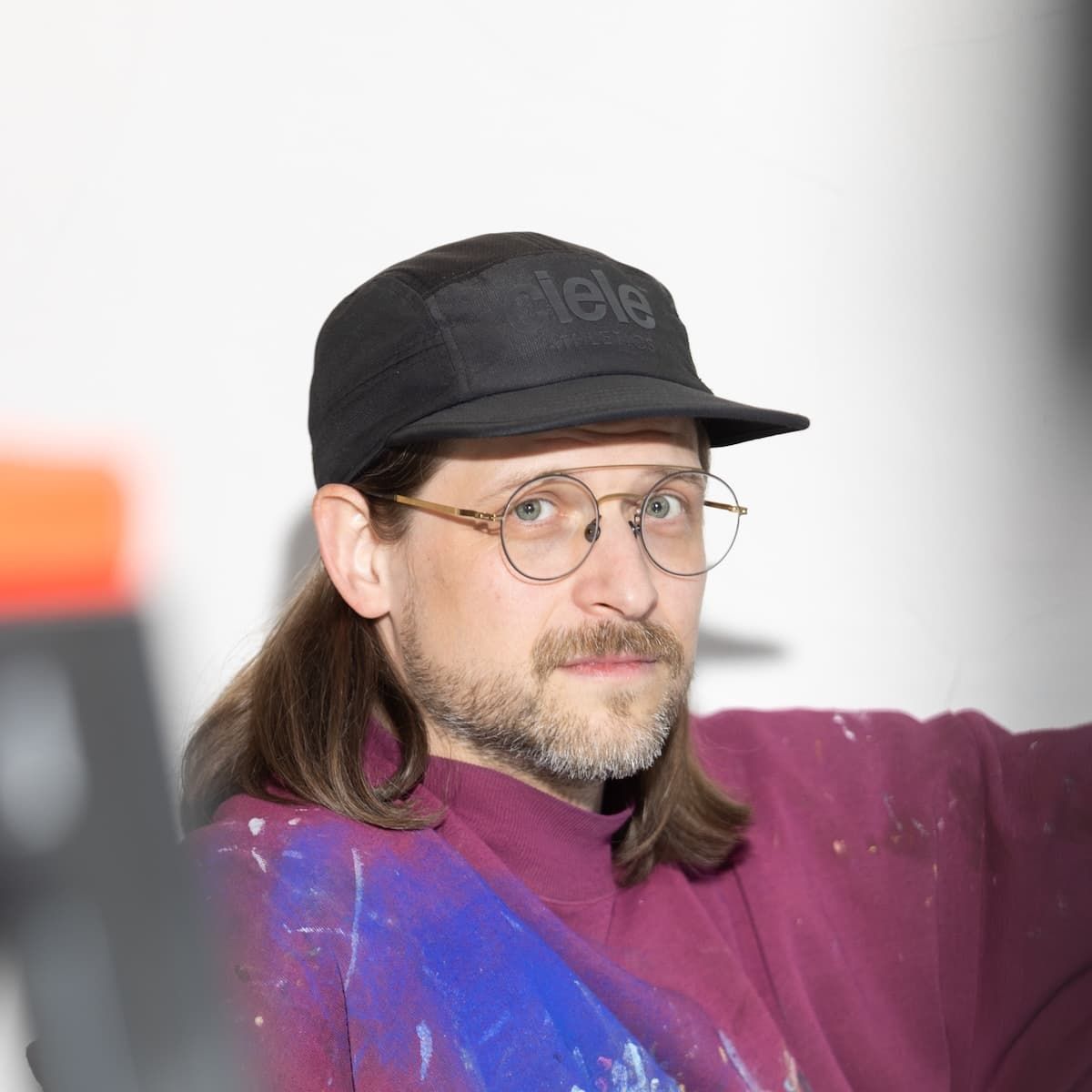
A mother walks through a landscape with her children, a weary older man behind them. An ordinary stroll, the kind you know from family photographs. Yet above their heads float demons and angels that the figures in the painting cannot see. Tadeáš Kotrba (b. 1986) is a painter who combines realistic painting of his family’s world with imaginary beings from the drawings of his late father, the sculptor Marius Kotrba. The result is one of the most personal dialogues in contemporary Czech art. Let us take a look together at why he is worth following.
Tadeáš Kotrba was born in Valašské Meziříčí and works in Rožnov pod Radhoštěm and in Prague. He grew up with art at home, as his father was a sculptor. He studied at the Secondary School of Applied Arts in Uherské Hradiště and in 2006 entered the Academy of Fine Arts in Prague (AVU). He began in the printmaking studio of Jiří Lindovský, passed through the studio of the visiting lecturer Jan Merta, and completed his studies in 2012 in the painting studio of Michael Rittstein. In 2011 he did a placement at Central Saint Martins College of Art and Design in London, and a year later his work appeared at the Summer Exhibition of the Royal Academy of Arts in London.
His printmaking background is still visible in his paintings today. Some passages recall drawing or etching, and line plays the same role as colour. In 2011, just as he was finishing his studies, his father Marius Kotrba, a distinctive sculptor and painter who stood out on the Czech scene in the 1980s, died unexpectedly. That loss later became one of the key driving forces of his work.
How does a Tadeáš Kotrba painting come about? It begins with small watercolour studies. On the canvas he then works with masking tape, applies oil paint with a palette knife and combines it with flat areas of acrylic. He often paints in thin glazes (translucent layers of paint) over oil on gesso (the primer coat of a canvas), or directly on unprimed linen. In places he deliberately leaves the canvas exposed. Fields of colour alternate with bare fabric, painting with drawing, density with lightness.
The result is layered paintings that read like a story. The curator Richard Drury wrote of his GASK exhibition that objective realism merges in them with an abstract, gestural expression. The figures are often delicately modelled and seem to vanish behind a curtain of snow or rain. Faded outlines suggest fragility and transience.
Tadeáš Kotrba’s main theme is the journey. Landscapes and architecture from his own life, paths across obstacles, the discovery of new spaces. The human figure often appears in them as a wanderer, a symbol of a person travelling through time and space. His models are usually photographs from walks with his family, from journeys and residencies. On his canvases you therefore meet his wife, his children and his father.
In her text for his Vienna exhibition, the curator Francesca Gavin drew attention to the recurring figures: a mother with children and an exhausted older man. Through them Kotrba speaks about masculinity, the climate crisis and the uncertainty of our times. Try pausing at one of his paintings and asking: where are these figures going? What awaits them beyond the horizon? And how much of that journey do you know from your own life?
Since 2019 Tadeáš Kotrba has been adding figures from his father’s drawings to his realistic scenes. Marius Kotrba drew them mainly in the last year of his life. They are restless, full of demons and angels. Kotrba takes individual figures and whole compositions from them and tries to transfer them faithfully, preserving their original lightness. The paintings thus connect two worlds: the realistic world of the family and an imaginary, grotesquely stylised world that the realistic figures do not see.
The culmination of this line was the exhibition Na hlavách obrů (On the Heads of Giants) at the Gallery of Fine Arts in Cheb (2021). The gallery director Marcel Fišer explained the title too: “As if the artist were standing on the heads of his father, continuing his work.” The giants are in the paintings literally, but also as a metaphor. The son stands on his father’s shoulders and carries on where he left off.
The dialogue with his father continued in Italy. In 2022 Kotrba spent a residency of the Eva Kahan Foundation in the Tuscan village of San Sano, a region he had visited as a child with his parents and which had also inspired his father. From church frescoes and altarpieces came the exhibition Rinascimento (Italian for Renaissance) at Galerie v Jilské 14 in Prague. At the opening of the exhibition Insight of Inspiration at the Anglo-American University in Prague (2023), he then performed a powerful gesture: with a hammer he smashed a plaster copy of a Renaissance fresco by Lorenzo di Pietro from the Santa Maria della Scala complex in Siena and laid the pieces on his father’s broken sculptures. Rebirth through breaking. A literal Renaissance.
Tadeáš Kotrba has exhibited since 2010 in the Czech Republic and abroad. His solo exhibitions include GASK in Kutná Hora (Vzpomínky zpola porušené, 2015), the House of Arts in Brno (Tři principy, 2017), the Třinec City Gallery (Family Demons, 2019), Galerie Kaple in Valašské Meziříčí (Řeka, 2021) and, in 2025, Kahan Art Space in Vienna (Harmonic Dissonance, curator Francesca Gavin). Among group shows, let us mention Fenomeander at DOX in Prague (2021) and exhibitions at Portheimka in Prague (2023 and 2024). In 2016 he was a finalist for the Rudolf Schlattauer Award at the Valmez Triennial. He regularly exhibits with The Chemistry Gallery in Prague.
His paintings are in the collections of the Central Bohemian Gallery in Kutná Hora, the Gallery of Fine Arts in Cheb, the Gallery of Fine Arts in Náchod and the East Bohemian Gallery in Pardubice. Institutional interest in a painter of his generation is a strong signal. Kotrba also offers something sought after in contemporary art: honest craft, a personal story and a theme that touches anyone who has ever lost someone close. Collectors receive paintings that will speak to them for a long time.
If you are heading to Prague, follow the programme of The Chemistry Gallery in the Holešovice Market, where his paintings appear. And when you stop in front of them, look closely above the heads of the figures. Perhaps you will glimpse something they cannot see themselves. The more art around us, the richer life is.
Tadeáš Kotrba (b. 1986 in Valašské Meziříčí) is a Czech painter and a graduate of the Academy of Fine Arts in Prague, where he studied printmaking with Jiří Lindovský and painting with Michael Rittstein. He is the son of the sculptor Marius Kotrba. His paintings are in the collections of several Czech galleries.
Tadeáš Kotrba begins with watercolour sketches, then on the canvas combines oil applied with a palette knife, flat areas of acrylic, masking tape and thin glazes. He often paints on unprimed linen and leaves parts of the canvas exposed. His printmaking training is evident in his painting.
Tadeáš Kotrba paints a person’s journey through the landscape, obstacles and the figure of the wanderer, often based on photographs from family walks and travels. Since 2019 he has inserted demons and angels from his late father’s drawings into his paintings. He also addresses masculinity, the climate crisis and uncertainty.
Tadeáš Kotrba has exhibited at GASK in Kutná Hora, the House of Arts in Brno, GAVU Cheb, DOX in Prague, Galerie v Jilské 14 and Kahan Art Space in Vienna, among others. He works with The Chemistry Gallery in Prague and is part of the Art Part Club curated selection.
In 2016 Tadeáš Kotrba was a finalist for the Rudolf Schlattauer Award at the Valmez Triennial. In 2012 his work was selected for the Summer Exhibition of the Royal Academy of Arts in London.
Tadeáš Kotrba combines honest painterly craft with a deeply personal story of dialogue with his father, and his paintings are in the collections of GASK, GAVU Cheb, GVU Náchod and the East Bohemian Gallery. In 2025 he had a solo exhibition in Vienna, which shows growing international interest.
Tadeáš Kotrba, 1986, Valašské Meziříčí. Painter, lives and works in Rožnov pod Radhoštěm and Prague. Studies: Secondary School of Applied Arts, Uherské Hradiště (2002 to 2006); Academy of Fine Arts in Prague (AVU), Printmaking Studio I (Jiří Lindovský, 2006 to 2009), visiting lecturer’s studio (Jan Merta, 2009 to 2010), Painting Studio III (Michael Rittstein, 2010 to 2012). Residencies and placements: Central Saint Martins College of Art and Design, London (2011); Eva Kahan Foundation residency, San Sano, Italy (2022). Awards: finalist of the Rudolf Schlattauer Award, Valmez Triennial (2016). Solo exhibitions (selection): Vzpomínky zpola porušené, GASK, Kutná Hora (2015); Tři principy, House of Arts of the City of Brno (2017); Family Demons, Třinec City Gallery (2019); Na hlavách obrů, GAVU Cheb (2021); Řeka, Galerie Kaple, Valašské Meziříčí (2021); Rinascimento, Galerie v Jilské 14, Prague (2022); Harmonic Dissonance, Kahan Art Space, Vienna (2025). Group exhibitions (selection): Summer Exhibition, Royal Academy of Arts, London (2012); Stavy mysli / Za obrazem, GASK (2017); Fenomeander, DOX, Prague (2021); Fyziognomie současnosti*, European Parliament, Brussels (2022); Portheimka, Prague (2023, 2024). Collections: Central Bohemian Gallery, Kutná Hora; Gallery of Fine Arts in Cheb; Gallery of Fine Arts in Náchod; East Bohemian Gallery in Pardubice. Collaboration: The Chemistry Gallery, Prague. Technique: oil, acrylic and watercolour on canvas or unprimed linen, drawing, installation, performance.
