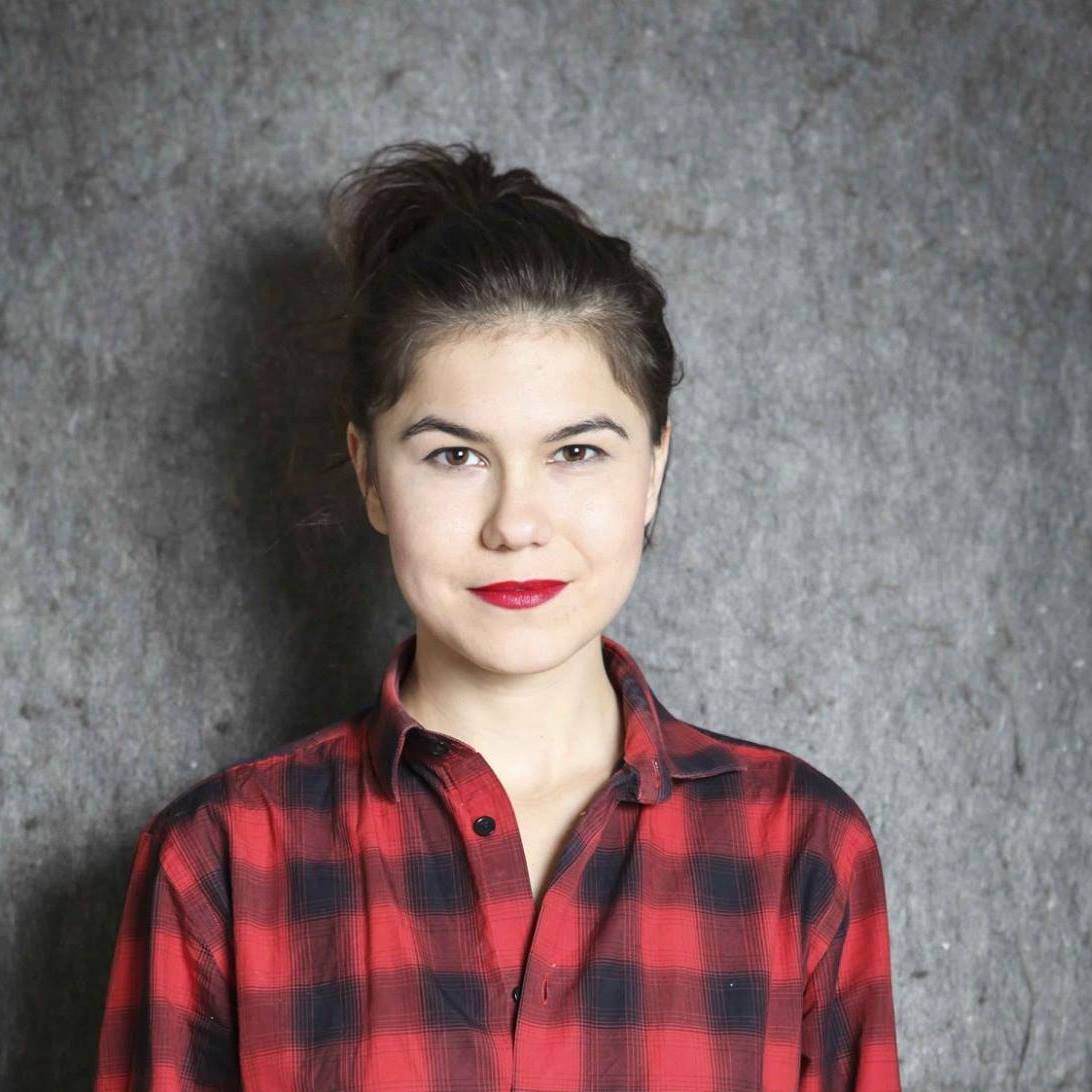
A wave carved from Carrara marble. A fish in the rapids, a heron, a newt, a frog of green serpentine. Stone that seems hard and cold turns in her hands into something soft, almost liquid. Tereza Štětinová (b. 1987) is a sculptor who began as a photographer and today works in marble, onyx, alabaster, wood, silk and feathers. Her works are in private collections, and on a façade in the centre of Prague they commemorate Jan Palach and Josef Toufar. Let us take a look together at why she is worth following.
Tereza Štětinová (née Příhodová) was born in Třebíč and grew up in Tasov in the Vysočina region. She studied at the Secondary School of Graphic Arts in Jihlava and then at the Department of Photography at FAMU in Prague, graduating in 2013. As a photographer she had several solo exhibitions, including at the Studio of Josef Sudek in Prague (Lekce samoty, 2012), at Berlínskej model and at Galerie Fiducia in Ostrava (Návrat vyběrače ptačích hnízd, 2016).
Gradually, however, she found that capturing the shape of things was not enough for her. She wanted to create it. In 2023 she lectured students at the FAMU Department of Photography about this journey from photography to sculpture, speaking about motivation, collaboration and perseverance. Today she devotes herself mainly to sculpture, objects and installations.
Tereza Štětinová’s material palette is as rich as a geological collection. She works with Carrara marble, with Arabescato, Botticino and Portugalo Rosso marbles, with Czech marble from Nedvědice and Supíkovice, with onyx, alabaster, selenite (a translucent mineral reminiscent of frozen light), serpentine, trachyte, granite, gneiss and sandstone. Among woods she chooses hornbeam, olive, ebony, linden, oak, birch and pine. She adds silk, wool roving, horsehair, latex and parrot feathers.
For her, material is not just a means. The accompanying text by Jan Kudrna for her exhibition at Hukvaldy this year speaks of a reduced artistic language, clear motifs and original materials that let their natural essence stand out. Try pausing by her sculptures and looking closely. Where does the drawing of the stone end and the sculptor’s hand begin? And what would the work tell you if you could touch it?
The most interesting moments are often those when hard meets soft. In Lazarus (2017) she combined oak with silk, onyx and marble, in Maškarády (2020) pine with horsehair and cotton, in Kostra velryby (2024) Carrara marble with latex. Stone here stops being merely a solid and eternal material. It becomes skin, fur, foam. Try it yourself next time: look on her sculptures for the place where materials meet, and watch how their meaning changes at that moment.
The themes of Tereza Štětinová come not only from personal experience but reach far beyond it: to myths, mysticism, religion, collective memory, literature and rituals. The archetypes of wings, masks and gestures recur, along with attributes of unspecified cultures. With her objects she builds her own landscapes and makes visible the traces of human presence from different times and places.
She often returns to water and the forest, to motherhood, to pain and joy, and to the border between the transient and the lasting. The cycle Genesis (2022) deals with the water’s surface, the tide and the wave in various kinds of stone, from Carrara marble to gneiss. In wood she made Dvě Madony (2021), in onyx Strážný anděl (2023), in Carrara marble Polibek (2023). What do they have in common? Hands, embrace, touch. A gesture that connects people with one another and with nature.
Jan Kudrna’s curatorial text from the Hukvaldy exhibition captures precisely how to read her works: where you expect a description, a sign appears. And the space for your own interpretation is left to you.
One of Tereza Štětinová’s most important works of recent years is the memorial on the façade of the former Borůvka Sanatorium in Legerova Street in Prague, where Jan Palach and Josef Toufar died. The plaques, unveiled in March 2025, bear sculpted hands that symbolise the gesture both men made for society. With Palach there is a flame, with Toufar a stone decoration with flowing holy water. A powerful theme expressed in a very quiet and dignified language.
At the same time her work opens up to nature with a new lightness. The sculptures from 2026 bear the titles Volavka, Rak, Klepeto, Čolek, Vážky, Ryba v peřejích and Splav. A whole small ecosystem of a stream carved in stone. In June 2026 she presented them at the exhibition Je jen jedno umění in the gallery of the Leoš Janáček International Music Festival in the Hukvaldy Court. The accompanying text there linked her sculptures with nature, the elements, folklore and the musical memory of Hukvaldy.
Together with artists such as Eva Koťátková and Eva Kmentová, Tereza Štětinová took part in Pavlína Morganová’s curatorial project at the hunt kastner gallery in Prague (Dotknout se zastaveného času, 2023). She has also exhibited at Bold Gallery (Tři těla, šest nohou, šest rukou, 2023), at Skleník at Prague Castle (Předjaří: Prchavé existence, 2025), at the Trade Fair Palace as part of the Jindřich Chalupecký Award exhibition (2022) and at the Blansko City Gallery (Brambory, 2022, together with Roman Štětina). Her sculptures have appeared in exhibitions of private collections at Magnus Art gallery: in 2025 in the exhibition of the designer Janja Prokić’s collection, Oči zavřít a přece uvidět, alongside works by Josef Bolf and Klára Hosnedlová, and a year later at the same gallery, this time as part of Oldřich Uttendorfský’s collection.
I show her marble sculpture in my lectures on investing in art. Why? Sculpture in noble stone is a craft that demands years, strength and patience, and there are not many young sculptors who master it so well. The fact that her works are going into private collections and that she was entrusted with creating the memorial to Palach and Toufar is a clear signal for collectors.
If you are heading to Prague, stop in Legerova Street at the former Borůvka Sanatorium and look at the hands bearing flame and water. Then you will know why it is worth watching what Tereza Štětinová carves next. The more art around us, the richer life is.
Tereza Štětinová (née Příhodová, b. 1987 in Třebíč) is a Czech sculptor who studied at the Department of Photography at FAMU and moved from photography to sculpture. She works in marble, onyx, wood and other natural materials. She is the author of the memorial plaques of Jan Palach and Josef Toufar in Prague.
Tereza Štětinová carves Carrara and Czech marble, onyx, alabaster, selenite, serpentine, trachyte, granite and gneiss. She also works with wood (hornbeam, linden, olive, ebony) and combines it with silk, wool, horsehair or feathers.
Tereza Štětinová draws on personal experience, myths, mysticism, religion, collective memory and rituals. She returns to water, the forest, motherhood, pain and joy, and the border between the transient and the lasting. The archetypes of wings, masks, hands and gestures recur in her work.
Tereza Štětinová’s memorial plaques can be seen permanently on the façade of the former Borůvka Sanatorium in Legerova Street in Prague 2. She has exhibited at the hunt kastner gallery, at Bold Gallery, at Prague Castle, at Magnus Art gallery and at Hukvaldy. She is also part of the Art Part Club curated selection.
Public sources list no specific awards for Tereza Štětinová. Her standing is shown by the commission for the memorial to Jan Palach and Josef Toufar and by her representation in the Janja Prokić collection.
Tereza Štětinová masterfully handles demanding sculpture in noble stone, which is not common among younger artists. Her works are going into private collections, and she was entrusted with creating a memorial to two significant figures of Czech history.
Tereza Štětinová (née Příhodová, also Tereza Příhodová Štětinová), 1987, Třebíč. Sculptor, formerly a photographer. Studies: Secondary School of Graphic Arts, Jihlava (2002 to 2006); FAMU, Department of Photography, Prague (2013). Solo exhibitions (selection): Lekce samoty, Studio of Josef Sudek, Prague (2012); Od medu k popelu, Berlínskej model, Prague (2015); Návrat vyběrače ptačích hnízd, Galerie Fiducia, Ostrava (2016); Murure, Polansky Gallery, Prague (2017). Group exhibitions (selection): Ostatky (with Karolína Rossí), Galerie NoD, Prague (2020); Jindřich Chalupecký Award 2022, Trade Fair Palace, Prague (2022); Brambory (with Roman Štětina), Blansko City Gallery (2022); Dotknout se zastaveného času, hunt kastner, Prague (2023); Tři těla, šest nohou, šest rukou, Bold Gallery, Prague (2023); Předjaří: Prchavé existence, Prague Castle (2025); Oči zavřít a přece uvidět, Magnus Art, Prague (2025); Je jen jedno umění, Hukvaldy Court (2026). Public space projects: memorial plaques of Jan Palach and Josef Toufar, former Borůvka Sanatorium, Prague 2 (2025). Collections: Janja Prokić collection; private collections in the Czech Republic. Technique: marble, onyx, alabaster, selenite, serpentine, trachyte, granite, wood, silk, wool, feathers.
