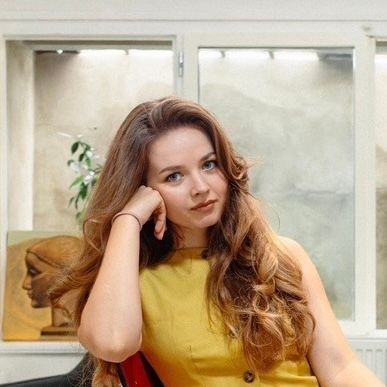
A door ajar. A window without blinds. A naked girl in a bathroom who takes no notice of you. An empty tram track at night. Nothing is happening, and yet you feel that something is about to. Ilona Koroman (b. 1998) is a Prague painter with Hungarian-Ukrainian roots whose paintings have the atmosphere of a film still. According to Forbes, her diploma work at AVU was sold out, and only a few months after graduating she opened her first major solo exhibition at Bold Gallery, which the weekly Respekt chose as its exhibition of the week. Let us look at why Ilona Koroman is one of the most interesting new names in contemporary Czech painting.
Ilona Koroman grew up in western Ukraine and in 2014 moved to the Czech Republic to join her parents. As she herself stresses, the main reason was the desire to study art, not the political situation. After a preparatory year during which she searched for her own style, she was accepted to the Academy of Fine Arts in Prague on her first attempt.
Studying was not easy. Figurative painting (painting of the human figure) was not much in favour at the school at the time, and in her words she felt like an oddity among her classmates. At defences she kept hearing that her motifs resembled socialist art. Yet the harshest criticism, in her own words, moved her forward the most.
She passed through three studios: Painting I of Robert Šalanda and Lukáš Machalický, Painting III of Josef Bolf and Marek Hošek, and finally the drawing studio of Alice Nikitinová and Matyáš Smetana, where she graduated in 2025. A semester at the Accademia di Belle Arti in Carrara, Italy, was also key for her; it broadened her interest in material and led her to sculpture, bronze casting and a lighter palette.
She began with gouache (an opaque water-based paint) on paper. Today she paints in oil on large canvases, which she stretches and primes herself (preparing the ground so that the paint holds well). She does not use ready-made supports; control over the material is essential to her. Oil, she says, demands patience, whereas tempera (paint bound with egg yolk) serves to capture a moment.
Earthy tones, browns and ochres, predominate in her paintings, in contrast with strong light and deep shadows. At first she painted real places and photographs. Today she constructs her paintings: she combines real sources with fantasy and with inspiration from older masters.
And this is where Ilona Koroman becomes truly interesting. She enjoys the early Renaissance, a time when painters had not yet mastered perfect perspective. For her diploma work she was inspired by the Venetian painter Vittore Carpaccio, whose compositions she deliberately shifted towards a Surrealist perspective. Walls lengthen, rooms are unnaturally tall, the space does not add up. And it is precisely this small discrepancy that creates a strange, dreamlike tension.
Notice the light too. In Ilona Koroman’s work it is rarely just the lighting of a scene but the main hero of the painting. A lit window in a dark house, a sharp strip of sun on paving, a night lamp above an empty road. The light sets the mood before you recognise what is happening in the painting. And that is why her painting feels more like a paused film frame than a staged scene.
What will you see in Ilona Koroman’s paintings? Windows, interiors, studios, bathrooms, housing estates, tram lines, empty roads and the night city. Lonely figures, abandoned objects, an old metal chair with a Formica seat. Everyday life that her imagination turns into an experience you will remember.
For her the window is a boundary between the private and the public, but it also works in reverse: sometimes she herself is the one being watched. The diploma series Za oknem thus asks who is actually looking and who is seen. And what about you, the viewer? Do you not become a bit of a voyeur (someone who secretly observes others’ private lives) in front of her painting?
Because of her origin, many people expect her to paint war. But she bets on everyday life. “Art does not have to deal only with difficult subjects,” she told Forbes. She wants her paintings to speak for themselves, not because of where she comes from. In her view, painting can be engaged at most indirectly, quietly.
In Respekt, the critic Jan H. Vitvar placed her paintings in the Czech tradition of civilism of Skupina 42 (a group of artists of the 1940s who painted the city, the periphery and the ordinary person). At first glance, however, in his view they seem rather unfamiliar. Try it for yourself next time: find a detail in her painting that does not belong to reality. Is it a wall that is too tall, or a strange light? And does it change how you read the whole scene?
From 14 January to 14 February 2026 she presented the solo exhibition Klíčovou dírkou at Bold Gallery in Prague. The gallerists Oldřich Hejtmánek and Petra Makuková offered it to her after the success of her diploma work. The curator Radek Wohlmuth divided some twenty new paintings, made in about half a year, into a night and a day light regime, alternating in a single space.
The keyhole here is a metaphor for a gaze that is never neutral. There is both curiosity and desire in it. The curator compares the atmosphere of the exhibition to Hitchcock’s film Rear Window. The painting Poznání works with Malevich’s Red Square, whose squares the painter also encoded in the paving. Do you like looking for hidden references? Here you will get your fill.
Even during her studies she twice exhibited at HIDDEN Gallery in Prague, in the exhibition Hygge and at the Christmas pop-up in 2023. In the HIDDEN éditions edition she also released a limited series of six original gouaches. The gallery also recorded the podcast Behind the Window with her about her diploma work. Today you can find her in the programme of Bold Gallery.
Why follow Ilona Koroman? Her diploma work attracted collectors and gallerists, Respekt chose her first solo exhibition as its exhibition of the week, and Vogue, Seznam Zprávy and Forbes have written about her. Critics compare her to the painter Moemi Yamamoto, another striking AVU graduate. Her painting is quiet and yet impossible to overlook, with its own visual language that joins the early Renaissance, film and today’s city.
If you are heading to Prague, follow the programme of Bold Gallery in Holešovice and take a close look at her canvases. Peek through the keyhole. You may not want to leave. The more art around us, the richer life is.
Ilona Koroman (b. 1998) is a painter with Hungarian-Ukrainian roots who lives and works in Prague. In 2025 she graduated from the drawing studio of Alice Nikitinová and Matyáš Smetana at the Academy of Fine Arts in Prague, and in 2026 she had her first major solo exhibition at Bold Gallery.
Ilona Koroman paints in oil on large canvases, which she stretches and prepares herself. She began with gouache on paper and also works with tempera. Earthy tones and strong contrasts of light and shadow predominate in her work.
Ilona Koroman paints windows, interiors, housing estates, tram lines and the night city. She is interested in the boundary between the private and the public, in the gaze and intimacy, and draws inspiration from the early Renaissance, Vittore Carpaccio and film.
Ilona Koroman has exhibited at Bold Gallery in Prague (Klíčovou dírkou, 2026) and at HIDDEN Gallery (2023). She is also part of the Art Part Club curated selection.
Public sources do not yet list any awards for Ilona Koroman. Her exhibition Klíčovou dírkou was chosen by the weekly Respekt as its exhibition of the week, and according to Forbes her diploma work at AVU was among the best of its year.
Ilona Koroman has her own visual language that joins the early Renaissance, film and the contemporary city. Shortly after graduating she was given a solo exhibition at Bold Gallery and drew the attention of collectors, gallerists and leading media.
Ilona Koroman, 1998. Painter of Hungarian-Ukrainian origin, lives and works in Prague. Studies: Academy of Fine Arts in Prague (studios Painting I, Robert Šalanda and Lukáš Machalický; Painting III, Josef Bolf and Marek Hošek; Drawing, Alice Nikitinová and Matyáš Smetana; graduated 2025). Exchanges: Accademia di Belle Arti di Carrara, Italy (one semester). Solo exhibitions (selection): Klíčovou dírkou, Bold Gallery, Prague (2026, curated by Radek Wohlmuth). Group exhibitions (selection): Hygge, HIDDEN Republika, Prague (2023); Holiday PopUp series*, HIDDEN Bořivojova, Prague (2023); AVU diploma exhibition, Prague (2025). Collaboration: Bold Gallery, Prague; HIDDEN Gallery, Prague (HIDDEN éditions). Technique: oil on canvas, large formats; gouache and tempera on paper.
