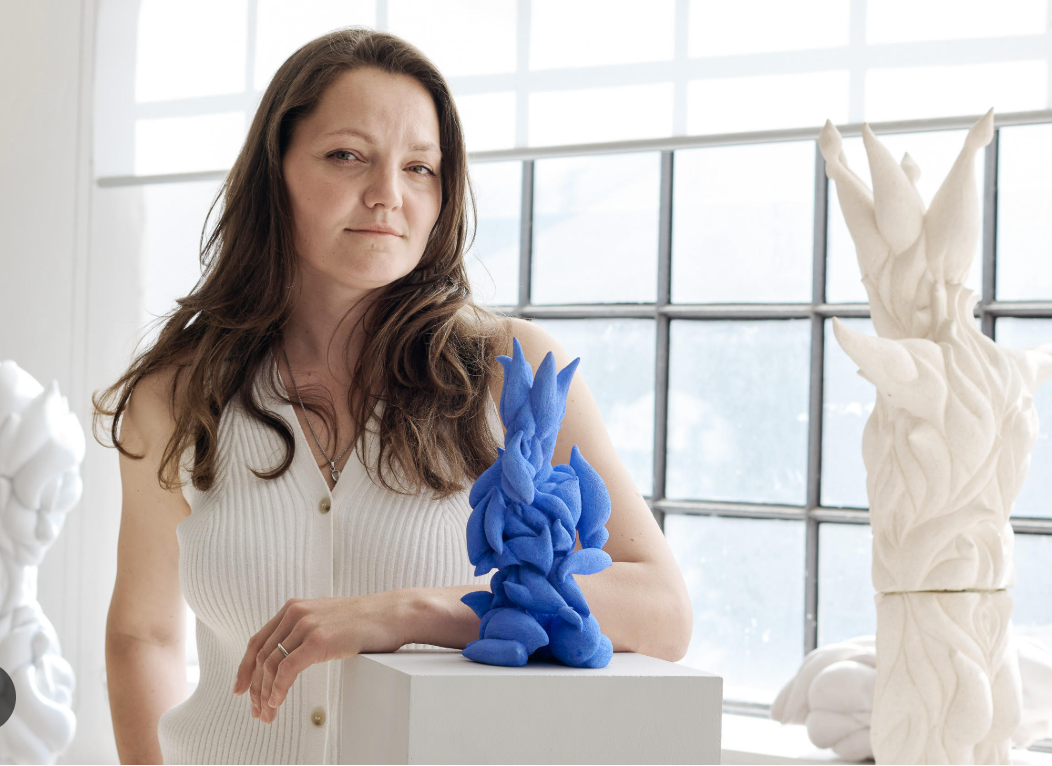
A sprite-like figure in golden slippers, its head a budding blue flower, its body stitched with coloured yarn into the shape of peacock wings. Beside it, a two-metre being on four red legs, its face propped up by long plaits. A fairy tale? A dream? Or a mother's diary? Magdaléna Roztočilová (b. 1989) is a sculptor who combines solid craftsmanship with unbridled imagination, and in her work monuments in public space meet surreal beings made of coloured resin. Let us look together at why she is worth knowing.
Magdaléna Roztočilová was born in Boskovice in the Blansko region and now lives and works in Prague. She studied at the Academy of Fine Arts in Prague in the sculpture studio of Jaroslav Róna, where she worked in both sculpture and painting. During her studies she completed a year-long placement with Krištof Kintera at UMPRUM and another with Florian Reither of the Austrian group Gelitin. Two very different models: Róna, with his magical, archetypal figure, and Kintera and Gelitin, with their playful, provocative approach to material. Both can still be felt in her work today.
She began taking commissions while still a student. "Sculpture is my path, my way of life, but above all my language," she said in an interview for Blanenský deník. Before each project, by her own account, she reads biographies and literature and researches the subject she wants to portray.
Few artists of her generation have so many realisations in public space behind them. For her native Boskovice she created a memorial to the victims of totalitarian regimes in 2015, and four years later a memorial to Cardinal Tomáš Špidlík, inspired by his coat of arms: a heart with a steel cross which, seen from the side, recalls a crown. She worked on the memorial for two years.
In 2019 she won the public competition for a bust of Milada Horáková, which now stands in the building of the Plzeň Regional Authority. In her words, it was her wildest commission, as she had only about four months for it. A year later she followed up with the exhibition Láska zocelená smrtí at MOON Gallery in Liberec, marking the seventieth anniversary of the judicial murder of Milada Horáková. As she herself explained, she wanted to show that we perceive the great figures of our history far too impersonally.
Among her largest realisations is also the sculpture Delichorn in Selb, Germany, the city of porcelain. Her sculptures thus live not only in galleries, but in towns where people encounter them every day.
She began with classical sculptural materials: clay and plaster (the traditional modelling material for casting). Gradually she expanded them with wool, textile, old clothing and metal. In recent years she has worked mainly with tinted and polished epoxy resin (a synthetic material that, once cured, keeps its shape and colour and can be sanded to a gloss), from which she also makes large objects. She combines it with ceramics and embroidery yarn.
Form and mass are essential to her, but so is colour. Unsurprisingly: she is an experienced painter and tunes the colour of her sculptures with a painter's sensibility. She also paints independently, in bold colours and with rich symbolism.
Try pausing at one of her sculptures and noticing the surfaces. Where does the glossy resin end and the matt ceramic begin? Why does the figure wear golden slippers? Every material says something in her work.
What will you see in Magdaléna Roztočilová's sculptures? The central theme is the human being and the question of how to express thought processes through the physical body. A recurring motif is the portrait, above all stylised self-portraits, faces and masks. Her figures are both figurative and abstract, fantastical, sometimes bizarre, with amorphous shapes reminiscent of flames. Gallerists mention the influence of Hieronymus Bosch and of surrealists such as Giorgio de Chirico and René Magritte (painters who built on dream logic and unexpected combinations of objects).
Her main themes include identity, femininity, dreams, memories, love and fear. As if her whole body of work were searching for different forms of reality through the search for her own. The idea of unity in multiplicity also recurs, which she developed, for example, in the exhibition of mosaics and sculptures Tajemství zahrady, loosely inspired by the Book of Genesis, in the Mythological Corridor of the Senate of the Parliament of the Czech Republic (2021).
In spring 2026 she presented the exhibition Kam se tělo nevejde at Studio Prám in Prague's Vysočany, curated by Iva Mladičová. The weekly Respekt chose it as its exhibition of the week. The new sculptures from 2024 to 2026 deal with the experience of motherhood, with its joy and tenderness, but also its worries and fears. The critic Jan H. Vitvar described them as empathetic records of life "here and now", full of hidden meanings, and praised how respect for tradition and experiment combine in her formal language.
These include Annino rozhodnutí, Chlupatá svoboda and the two-metre Tvar trifida, whose face made of plaits recalls Arcimboldo's portraits (faces composed of fruit, vegetables and objects). The artist wishes her sculptures to be read like books. With an open ending, where everyone finds their own story.
Magdaléna Roztočilová is a founding member of Studio Prám, an artistic community of graduates of AVU and UMPRUM that has been based for more than ten years in a former factory laundry in Vysočany. She makes independent works and sculptural commissions there and also works as a curator. She shares the studio with her husband, the artist Jakub Roztočil. In autumn 2024 they exhibited together at Galerie Pekelné sáně the project Dějiny se mají vyprávět jako příběh.
Her works appeared in the exhibition Trafo Art Salon 2025 at Trafo Gallery in Prague and during Prague Art Week 2026 in the series Bytová kultura at the premises of Sotheby's International Realty, where her colourful sculptures contrasted with a functionalist flat and with black-and-white works by David Krňanský, Tereza Zelenková and Daniel Vlček. She has also exhibited abroad, for example in Brussels.
Why follow her? She combines two registers that rarely meet in one person: the author of public monuments and the sculptor of intimate, dreamlike objects. Her sculptures are meant for life in an interior, not for a gallery monologue. In the LOOP podcast she herself says that she sees the meaning of art in being surrounded by objects that inspire us. For collectors looking for a figurative sculpture with strong colour and a story, this is a name worth attention.
If you are heading to Prague, follow the programme of Studio Prám and Trafo Gallery and see her sculptures up close. You will see how beings you will remember are born from resin, ceramics and yarn. The more art around us, the richer life is.
Magdaléna Roztočilová (b. 1989 in Boskovice) is a Czech sculptor and painter, a graduate of Jaroslav Róna's studio at the Academy of Fine Arts in Prague. She is a founding member of Studio Prám and the author of a number of monuments in public space.
Magdaléna Roztočilová starts from classical clay and plaster, but in recent years she has worked mainly with tinted and polished epoxy resin. She combines it with ceramics, textile, embroidery yarn and metal, and also paints.
Magdaléna Roztočilová examines how to express human thought processes through the body. Stylised self-portraits, faces and masks recur in her work, as do dreams, femininity and, in her latest sculptures, the experience of motherhood.
Magdaléna Roztočilová has exhibited at Studio Prám (Kam se tělo nevejde, 2026), at Trafo Gallery, at Galerie Pekelné sáně, in the Senate and at MOON Gallery in Liberec. Her monuments stand in Boskovice, in Plzeň and in Selb, Germany, and she is also part of the Art Part Club curated selection.
Magdaléna Roztočilová won the public competition for a bust of Milada Horáková for the Plzeň Regional Authority (2019). Her exhibition Kam se tělo nevejde was chosen by the weekly Respekt as its exhibition of the week.
Magdaléna Roztočilová combines the author of public monuments with the sculptor of intimate, dreamlike objects of vivid colour. Her sculptures are meant for life in an interior and offer collectors a figurative sculpture with a story.
Magdaléna Roztočilová (also Magdalena Roztočilová), 1989, Boskovice. Sculptor and painter, lives and works in Prague. Studies: Academy of Fine Arts in Prague, sculpture studio of Jaroslav Róna. Placements: Krištof Kintera (UMPRUM, year-long placement); Florian Reither (Gelitin). Public-space realisations (selection): memorial to the victims of totalitarian regimes, Boskovice (2015); bust of Milada Horáková, Plzeň Regional Authority (2019, winning entry of a public competition); memorial to Cardinal Tomáš Špidlík, Boskovice (2019); sculpture Delichorn, Selb, Germany. Solo exhibitions (selection): Láska zocelená smrtí, MOON Gallery, Liberec (2020); Tajemství zahrady, Senate of the Parliament of the Czech Republic, Prague (2021); Kam se tělo nevejde, Studio Prám, Prague (2026, curator Iva Mladičová). Group exhibitions (selection): Dějiny se mají vyprávět jako příběh* (with Jakub Roztočil), Galerie Pekelné sáně (2024); Trafo Art Salon 2025, Trafo Gallery, Prague (2025); Bytová kultura, Sotheby's International Realty, Prague Art Week (2026). Collaboration: Trafo Gallery, Prague; Studio Prám (founding member). Technique: epoxy resin, ceramics, textile and yarn, clay, plaster, metal; painting.
