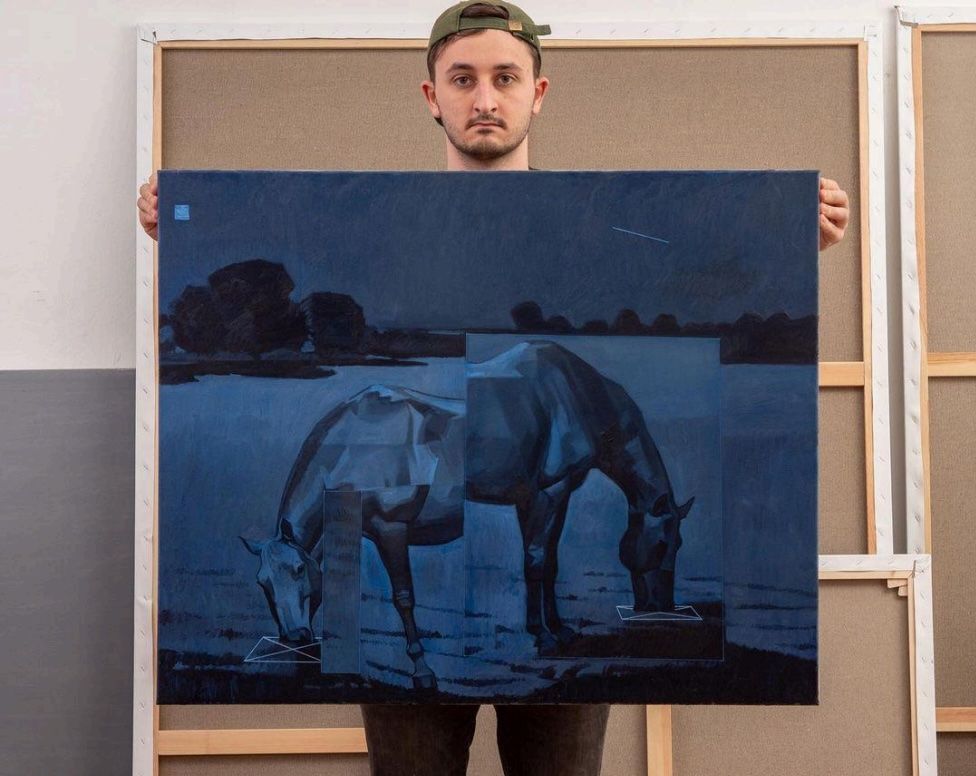
The leaves on the trees are angular. Water flows in regular little cubes and the lawn looks as if someone had rendered it. At first glance a Prague street, at second glance a scene from a computer game. Petr Dejmek (b. 1997) is a painter who uses hyperrealist painting to explore where reality ends and simulation begins, and who often casts himself in his pictures as the main character. Let us look together at why he is worth following.
Petr Dejmek comes from Prague and arrived at painting by the solid route of craft. He studied applied painting at the Secondary School of Arts and Crafts in Prague and, within the Erasmus+ programme, spent a placement at Metropolitan College in Birmingham, England. He gathered successes as a student. He repeatedly won the Figura competition in the figure painting category and three times in a row (2016 to 2018) reached the final round of the BP Portrait Award, the prestigious portrait competition of London's National Portrait Gallery.
In 2016 he entered the Academy of Fine Arts in Prague (AVU), first in the studio of painting restoration under Adam Pokorný. For five years he thus devoted himself to caring for other people's paintings before he began painting his own in earnest. Then he took a decisive step and moved to the painting studio of Robert Šalanda. The restorer's training is still felt on his canvases today: patience, precision and a feeling for the surface of the picture. He completed his studies in 2023 with the diploma thesis Neskutečná realita, in which he explored, through pictorial narrative, the theory of determinism (the idea that everything that happens is predetermined by a chain of causes).
Petr Dejmek paints in acrylic and in oil on canvas, often in large formats of around two metres. Technically he proceeds from hyperrealism (painting that imitates photography so faithfully that at first glance you can hardly tell them apart). But what he paints with photographic precision was never a photograph. His source is the world of computer games.
In the pictures you recognise streets that recall Prague's Letná: plastered walls, a Chinese restaurant or a pub with a beer advertisement. Yet everything is slightly angular, as if someone had converted reality to low resolution. Dejmek borrows characters and situations, for example, from the GTA series (Grand Theft Auto, action games with an open city through which the player moves freely). CJ, the protagonist of one of the instalments, therefore appears in his pictures. And beside him, often the author himself.
The result is strangely unsettling. You are looking at a carefully painted picture that depicts a digital copy of a city, which in turn imitates a real city. What is the original here? And what the copy?
Beneath the playful surface lies philosophy. Petr Dejmek works with the concept of the simulacrum as described by the French philosopher Jean Baudrillard (a copy that has no original and yet feels more real than reality itself). He is interested in Nietzsche's idea of eternal return and in the question of free will. Do we really decide for ourselves? Or do we move along a script written in advance, like a character in a game that someone controls?
The accompanying text for his exhibition Alt + 25 (by Bára Alex Kašparová) captured it in shorthand: in the angular world of the pictures, only one thing remained without edges. "Only the murder remained without edges." The very title of the exhibition refers to a keyboard shortcut, which can be imagined as an invisible cursor above our heads. A pointer that leads us even when we do not know about it.
Try pausing at Dejmek's pictures and looking for yourself. The author paints himself into the scenes deliberately, so that you too may recognise your own everyday situations: the way home, waiting in front of a pub, a dull afternoon in town. How many times a day do you do things you did not actually choose yourself? And how much of your day could be replayed, like a saved position in a game?
The titles of his pictures speak the language of gamers: Final Boss (the last and strongest opponent of a game), Vacation Mod (a mod, that is, a user modification of a game), Mise M51, Guard Bot and Powering down. His newer large-format canvases from 2023 to 2024 develop the same theme. But game aesthetics are no longer just a backdrop. They become a way of looking at today's world, in which we spend more and more time on screens and the boundary between physical and virtual reality slowly dissolves.
Dejmek is not writing a manifesto against games. According to the text accompanying the exhibition, fictional worlds fascinate him. Game aesthetics attract him with their new complexity and their ability to draw a person into another world to which one can escape from the duties of everyday life. His pictures are thus not a critique, but rather an honest report on how a generation that grew up with a controller in hand perceives reality today.
Petr Dejmek has exhibited, for example, at Point Gallery in Prague (Medium, 2019, together with Ivo Simon) and at the Museum Montanelli gallery in Osík near Litomyšl (Prolínání, 2019). In 2023 he presented the solo exhibition Alt + 25 at The Chemistry gallery in Dům Radost in Prague's Žižkov (curator Petr Hájek). In autumn 2024 curators and gallerists from Prague Art Week, KodlContemporary, Pro arte and Artslimit selected him for the Young Selection showcase at Palác Savarin, where ten young artists worth paying attention to were presented.
Why follow him in particular? He combines two things that rarely meet in young Czech art: classical painting craft, honed by restoration training and portrait competitions, and a thoroughly contemporary theme. Hyperrealist painting with subjects from computer games appeals to collectors from the generation that itself grew up on GTA. At the same time it holds up before those who look in a picture above all for honest painting.
If you are heading to Prague, follow the programme of galleries devoted to young painting and see Petr Dejmek's pictures up close. You will see how questions of freedom and chance hide beneath the angular leaves. The more art around us, the richer life is.
Petr Dejmek (b. 1997 in Prague) is a Czech painter and graduate of the Academy of Fine Arts in Prague, where he studied painting restoration and then painting in the studio of Robert Šalanda. He became known for hyperrealist painting that connects the Prague setting with the aesthetics of computer games. He is part of the Art Part Club curated selection.
Petr Dejmek paints in acrylic and oil on canvas, often in large formats of around two metres. Technically he proceeds from hyperrealism, that is, painting that faithfully imitates photography. He owes the foundation of his craft to studying painting restoration and to figure and portrait painting.
Petr Dejmek explores the dialogue between the physical world and the virtual reality of computer games, especially the GTA series. He works with Jean Baudrillard's concept of the simulacrum, with determinism and with the question of free will. He often paints himself into his pictures as the main character.
Petr Dejmek has exhibited at Point Gallery, at Museum Montanelli in Osík, in a solo show at The Chemistry Gallery in Dům Radost (Alt + 25, 2023) and at the Young Selection showcase during Prague Art Week 2024. His works can also be found in the Art Part Club curated selection.
Petr Dejmek reached the final round of the BP Portrait Award three times (2016 to 2018). He won the Figura competition in the figure painting category twice (2015 and 2016) and in 2016 took 2nd place in the CEMACH competition.
Petr Dejmek combines classical painting craft with a thoroughly contemporary theme of digital worlds. In 2024 gallerists and curators chose him among the ten young talents of the Young Selection showcase, and his hyperrealist painting appeals to a new generation of collectors.
Petr Dejmek, 1997, Prague. Painter, hyperrealist painting. Studies: Secondary School of Arts and Crafts in Prague, applied painting (2012 to 2016); Metropolitan College, Birmingham, UK (Erasmus+, 2015); Academy of Fine Arts in Prague, painting restoration studio (Adam Pokorný, 2016 to 2021) and painting studio of Robert Šalanda (2021 to 2023), diploma thesis Neskutečná realita (2023). Awards and competitions: BP Portrait Award, final round (2016, 2017, 2018); Figura, first prize in the figure painting category (2015, 2016); CEMACH, 2nd place (2016); Figurativas, final round (2017). Exhibitions (selection): Medium (with Ivo Simon), Point Gallery, Prague (2019); Prolínání, White Gallery and Museum Montanelli, Osík near Litomyšl (2019); Diplomky AVU 2023, Prague (2023); Alt + 25, The Chemistry Gallery, Dům Radost, Prague (2023); Young Selection, Prague Art Week, Palác Savarin, Prague (2024). Technique: hyperrealist painting, acrylic and oil on canvas.
