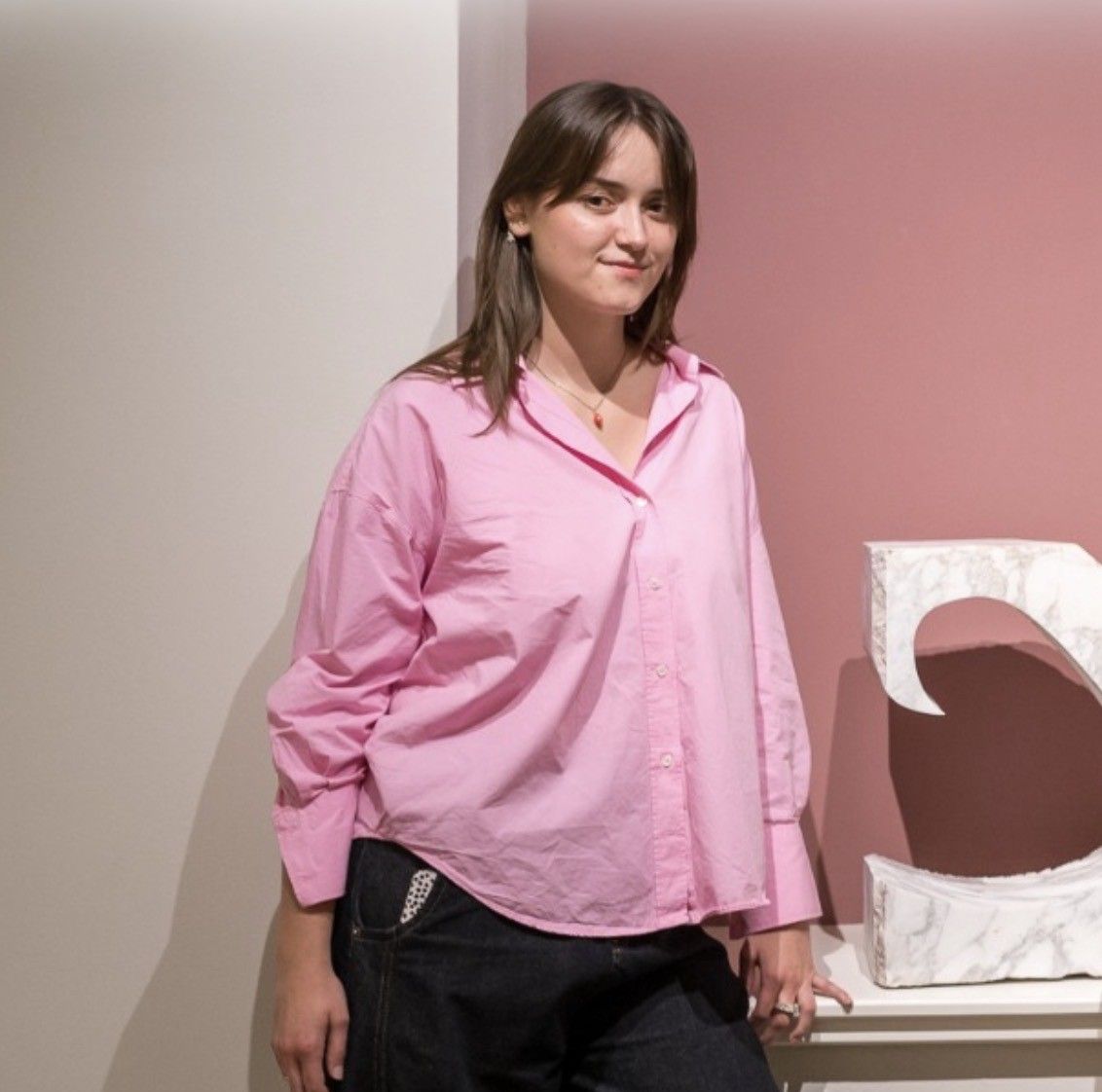
Heated sauna boards, cold feet, a blue monochrome canvas. A crop of the body so close that it turns into a landscape. And all of it painted without a single brushstroke. Sára Konečná (b. 2002) paints with an airbrush and, while still a student at the Academy of Fine Arts in Prague, collects one exhibition after another. Gallerists compare her to the most prominent painters of her generation. Let us look together at why she is worth following.
Sára Konečná's path to painting was unexpected. She studied at the Secondary School of Graphic Arts in Prague and had not originally planned on painting at all. "I did not study painting, I am a trained graphic designer," she says in an interview for Forbes. But she did not feel the same drive in graphic design as her classmates, so she decided to try her luck at AVU.
It did not work out the first time. She got into the Academy of Fine Arts only on her second attempt. As she herself recalls, what helped most were the months when she shut herself in the studio and simply painted. Today she studies in the Painting I studio, led by Robert Šalanda and Jan Kostohryz. The painter Petr Dejmek, for example, also came from the same studio. All the more interesting that Sára has found her own way in a classically painterly environment, quite literally without a brush.
And how did she come to the airbrush? Entirely by chance. At AVU she felt behind her classmates, who had more experience with classical painting. Then she found a forgotten compressor in a storeroom. In her words, it was a way to overcome a crisis. A makeshift solution became her signature.
The airbrush (a painter's spray gun driven by compressed air) allows her to create smooth colour transitions that would be hard to achieve with a brush. She works with masking tape that separates the individual parts of the picture. She colours them gradually, one after another, and sees the final result only at the moment when she peels off the last piece of tape. The tape is thus not just a tool but also a drawing surface.
The airbrush is no novelty in art. For a long time it belonged mainly to advertising, illustration and record sleeves, and it was brought into galleries to any great extent only by the American hyperrealists in the 1970s. Sára Konečná, however, does not use it for photographic precision. She uses its softness, its ability to spread colour like mist and to create light that seems to come from inside the picture.
The result is pure colour planes, soft transitions, depth and a peculiar atmosphere. She combines sprayed colour with flat painting to create volume and subtle tonal transitions. Try to imagine it: a picture that the painter paints all day without actually seeing it. What tension there must be when she pulls off the last piece of tape?
What will you see in Sára Konečná's pictures? The basis of her latest works is the human body, explored in detailed crops. It is not about eroticism, but about personal testimony. She perceives the female body not as fragile, but as a source of strength. The Chemistry Gallery describes her work as dealing with personal memories, corporeality, intimacy and sensory experience.
Her previous cycle Studený nohy, rozpálená prkna revolved around the sauna, where heat and cold, tension and release meet in one place. A series of monochrome blue canvases also came out of it. Her early works, by contrast, were narrative, at times even horror-like. Today her painting is moving towards minimalist compositions that economically create both space and figures.
Try pausing at her pictures and looking for what exactly you see. Is it a shoulder or a hill? A knee or a dune? The crop is so close that the body stops being a body and becomes a landscape. And then it returns again. That is the magic of her painting: a balance between tension and lightness.
Notice the colour too. Blue is not merely cold in her work, nor pink merely sweet. Pure colour planes carry the mood before you recognise the motif. The picture first affects you as a feeling, and only then as a story. And perhaps that is exactly why you remember it.
The year 2026 was exceptionally intense for Sára Konečná. From April to June she presented the solo exhibition Hothead at Dům Radost in Prague, organised by The Chemistry Gallery. The gallery described her as one of the most distinctive young voices of contemporary figurative painting, and according to Forbes the exhibition was also very commercially successful. The gallery's artistic director Petr Hájek compares her to Vojtěch Kovařík, one of the most closely watched Czech painters of the young generation.
In the same year the curator Radek Wohlmuth included her in the group exhibition Freeze Frame? at Bold Gallery in Prague, where she exhibited alongside Daniel Balabán, Jakub Špaňhel and Radka Bodzewicz. She has also had solo shows at the Okraje gallery in Tábor (Ráno co ráno) and at Hidden Gallery in Žižkov. She is preparing an exhibition with the sculptor Tereza Štětinová at the European Arts gallery.
She herself keeps her feet on the ground. She admits that when exhibition offers arrive while one is still studying, one feels one cannot refuse them. But she does not want to repeat three exhibitions in one year, so as not to burn out. In the future she wants to focus on transformation, interpersonal relationships, inner states and calm.
Sára Konečná is among the youngest names in contemporary Czech painting. Her pictures have appeared at The Chemistry Gallery, Bold Gallery, the Okraje gallery and Hidden Gallery, all before finishing her studies.
Why follow her? She has a recognisable hand that she built in her own way, and a technique you do not often see in Czech painting. The interest of galleries and collectors while still studying is a strong signal. And if the comparison to generational peers who reached important collections within a few years is confirmed, now is the ideal moment to start following her work.
If you are heading to Prague, follow the programme of The Chemistry Gallery and Bold Gallery and see her canvases up close. You will see how colour spreads like mist and how a body full of strength emerges from it. The more art around us, the richer life is.
Sára Konečná (b. 2002) is a Czech painter and student of the Painting I studio of Robert Šalanda and Jan Kostohryz at the Academy of Fine Arts in Prague. She originally trained in graphic design at the Secondary School of Graphic Arts. She has already had several solo exhibitions during her studies.
Sára Konečná paints with an airbrush, that is, a spray gun driven by compressed air, and combines it with flat painting. She works with masking tape, which allows pure colour planes and smooth transitions.
Sára Konečná focuses on the human body in detailed crops, personal memories, intimacy and sensory experience. She understands the female body as a source of strength, not fragility. Her previous cycle Studený nohy, rozpálená prkna was devoted to the sauna.
Sára Konečná has exhibited solo at The Chemistry Gallery (Hothead, 2026), at the Okraje gallery in Tábor and at Hidden Gallery, and in the group exhibition Freeze Frame? at Bold Gallery. She is also part of the Art Part Club curated selection.
No awards for Sára Konečná are listed in public sources so far; she is still a student at AVU. Her growing standing is shown by solo exhibitions in respected Prague galleries while still studying.
Sára Konečná has a recognisable hand and an airbrush technique unusual in Czech painting. Galleries compare her to the most prominent painters of the young generation, and according to Forbes her exhibition Hothead was also very commercially successful.
Sára Konečná, 2002. Painter, lives and works in Prague. Studies: Secondary School of Graphic Arts, Prague; Academy of Fine Arts in Prague, Painting I studio, Robert Šalanda and Jan Kostohryz (current student). Solo exhibitions (selection): Ráno co ráno, Okraje gallery, Tábor; Hidden Gallery, Prague; Hothead, The Chemistry Gallery, Dům Radost, Prague (2026). Group exhibitions (selection): Freeze Frame?*, Bold Gallery, Prague (2026). Collaboration: The Chemistry Gallery, Prague. Technique: airbrush, acrylic and spray on canvas, masking tape, pure colour planes.
